


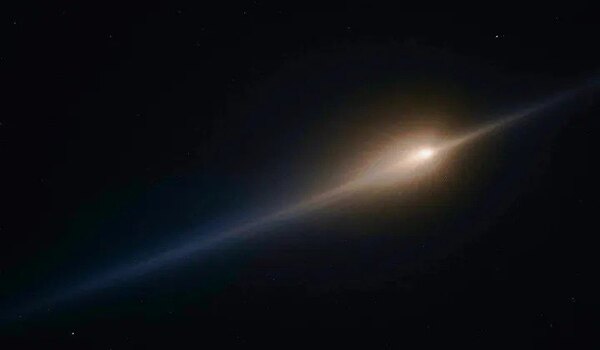
The interstella object 3I/ATLAS, which passed through our Solar System in 2025, continues to surprise astronomers and spark debate about its structure and behavior. New analyses now suggest that the strange “anti-tail” observed around it may not be made of ordinary dust, but rather a swarm of solid objects whose nature remains unknown.
These conclusions are based on calculations and interpretations presented by Professor Avi Loeb of Harvard University, one of the leading figures in the study of interstellar visitors such as ʻOumuamua and Borisov.
Throughout November 2025, post-perihelion images of 3I/ATLAS — that is, after it passed its closest point to the Sun — revealed a curious structure: a tear-shaped elongated coma, about one arcminute in length and pointing toward the Sun.
This is unusual because comet tails normally point away from the Sun, and an “anti-tail,” which points toward it, only appears under specific alignment conditions OR when the particles involved do not behave like ordinary cometary dust. In the case of 3I/ATLAS, the imagery suggested something more complex.
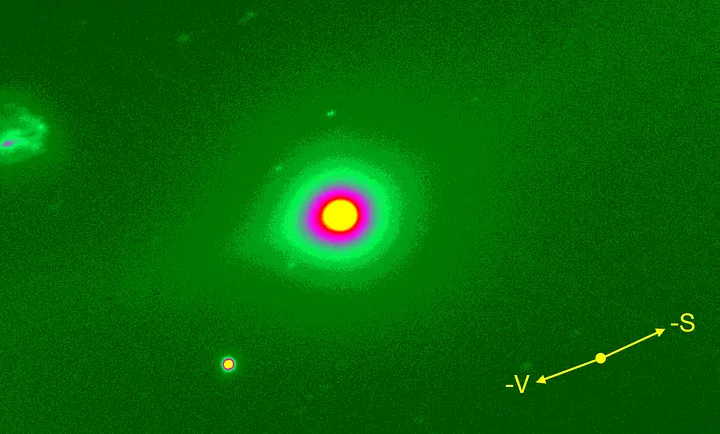
During the same period, NASA’s JPL Horizons system detected a non-gravitational acceleration acting on 3I/ATLAS. According to Professor Avi Loeb, this acceleration has a magnitude of only 0.0002 of the Sun’s gravitational force, acts in the radial direction, pushing the object away from the Sun, and decreases as the heliocentric distance increases, following exactly the same mathematical pattern as solar gravity.
This creates a curious scenario: the ratio between this extra force and gravity remains constant throughout the orbit, as if 3I/ATLAS were being slightly “repelled” from the Sun in a very precise way.
And what if there is a swarm of objects around it?
Here comes the most fascinating hypothesis. Loeb suggests that if 3I/ATLAS is accompanied by a swarm of solid objects, these small bodies would not experience the same non-gravitational acceleration—because it seems specific to 3I/ATLAS.
If this is true, 3I/ATLAS is pushed slightly away from the Sun, while the swarm objects are not; thus, the objects would end up closer to the Sun than 3I/ATLAS. The difference is small but observable.
At the object’s current distance, this separation would amount to about 54,000 kilometers, which in the sky corresponds to 0.7 arcminutes—exactly the size seen in the luminous elongation. In other words, the tear-shaped form could literally be the luminous shadow of the swarm.
For the general public, it may seem strange to imagine a “swarm” accompanying an interstellar object. But physically, it makes sense. According to Loeb, even if these objects carry only 0.001% of 3I/ATLAS’s total mass, if they are numerous enough—for example, a trillion fragments—they can present 100 times more surface area than the main object.
This causes 99% of the light reflected by the system to come from these small fragments. This explanation matches images from the Hubble Space Telescope, taken on July 21, 2025, which show a bright coma disproportionate to the estimated size of 3I/ATLAS.
Why does the anti-tail remain even after perihelion?
Even more intriguing is that the tear-shaped form persisted before perihelion, during the approach to the Sun, and afterward, when the object was already moving away.
This only makes sense if the extra acceleration continues to follow the same mathematical pattern (1 / distance²) and the swarm of fragments remains organized in the same angular region relative to the Sun.
In other words, the anti-tail does not disappear because it does not depend on ice evaporation, but rather on the difference in acceleration between the object and its accompanying fragments. This reinforces that the objects are non-evaporative, as Loeb points out—very different from the classical behavior of comets.
So… what are these objects?
This is the central question that fascinates scientists. If the antitail is truly associated with a cluster of non-evaporating objects, then:
- They are not ice particles.
- They are not jets of evaporated gas.
- They do not behave like ordinary dust.
- Their origin is not easily explained.
According to Avi Loeb, this raises a fundamental question: are these objects natural rocky fragments, structures formed during interstellar travel, or something entirely different?