



“The probability that artificial structures exist on the lunar surface is greater than 50%.”
This is the emphatic claim of theoretical physicist Maaneli “Max” Derakhshani, who argues that our satellite conceals evidence of non-human technology that has been ignored.
According to the University of Utrecht PhD, the Moon is not merely a barren desert of dust. His research points to the existence of formations that defy any standard geological model and should be treated as “technosignatures” of an extraterrestrial civilization.
These revelations emerge at a time of heightened tension for space exploration. NASA has been forced to delay the timelines of the Artemis II and III missions, canceling key launches due to critical hydrogen leaks and technical failures.
As humanity awaits an uncertain return to the Moon, experts like Derakhshani suggest that the agency’s caution may go beyond technical considerations. Could it be that the slowdown of the Artemis program masks a fear of what might be found upon arrival?
The Mystery of Paracelsus C Crater
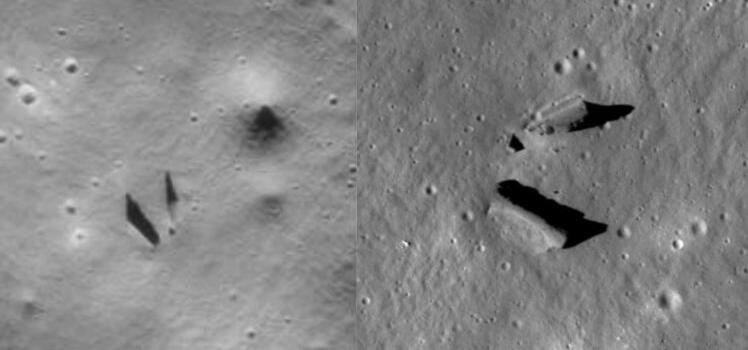
One of the most controversial aspects of Derakhshani’s research centers on Paracelsus C crater. Using artificial intelligence to analyze images from the LRO spacecraft, structures with perfectly straight right angles were detected.

These formations reach up to 30 meters in height and more than 100 meters in length. One particularly striking structure has a “T” shape and, according to the physicist, is impossible to explain solely through natural erosion caused by micrometeorites.
“Geology does not normally produce rectangular formations like this,” the specialist noted on Ross Coulthart’s Reality Check program. He believes these objects are anomalies that the scientific community should urgently investigate rather than dismiss.
National Security and Photographic Censorship
Why is there no official clarity regarding these discoveries? Derakhshani points to the 1958 Space Act, which requires NASA to classify any discovery that could affect the national security of the United States.
The physicist also recalled the 1994 Clementine mission. Although it was presented as a scientific endeavor, its deputy director, Dr. John Brandenburg, admitted years later that the real objective was to monitor whether “someone else” was building on the Moon.
At present, many official images display blurred areas or color blocks that obscure the terrain. This apparent photographic censorship reinforces the theory that sensitive information is being concealed from the general public.
Physical evidence: heat and unusual materials
The investigation is not limited to photographs. International missions have detected a “hot spot” in the Compton–Belkovich region that emits 20 times more heat than the surrounding areas, a phenomenon that still lacks a definitive explanation.

In addition, the presence of single-walled carbon nanotubes in lunar soil has been confirmed. This is an extremely advanced material that, on Earth, requires controlled manufacturing processes and does not occur naturally.
The weight of official silence
The reluctance to disclose information on these topics may be linked to the 1960 Brookings Institution report. At the time, NASA was warned that contact with superior technology could destabilize human society.

However, Derakhshani believes the world is ready for the truth. As the Artemis missions struggle to overcome their technical limitations, the secrecy surrounding what truly exists on the Moon appears to be nearing its end.
Are we looking at nothing more than unusual rocks, or the ruins of an ancient presence? The answer may be waiting for us on the far side, much sooner than official agencies are willing to admit.
The full interview between Coulthart and Derakhshani can be viewed below:




“Natural satellite”? Are you sure?