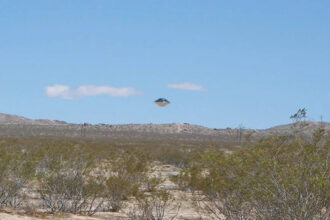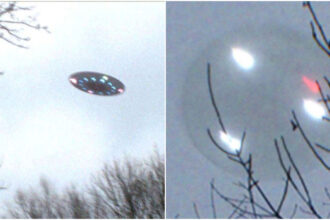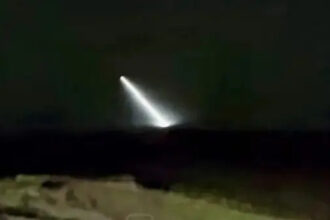




Previously classified UK intelligence files reveal that the British armed forces seriously considered the possibility that unidentified flying objects were linked to non-human, potentially extraterrestrial technology capable of outperforming any known aircraft.
The documents show that during the 1990s, the Defence Intelligence Staff, linked to the UK Ministry of Defence, was formally tasked with analysing so-called “Unidentified Aerial Phenomena”, now known as UAPs. The issue was treated not as curiosity, but as a potential national security threat and also as a strategic opportunity.
According to a report published by The Times, internal memoranda and files deposited at the National Archives in Kew, southwest London, confirm that the British military approached the possibility of extraterrestrial technology with extreme caution and seriousness, contrary to the idea that the subject was regarded merely as folklore.

An internal memorandum dated 4 March 1997 stated that if a significant number of people reported strange objects in the sky, this suggested the possibility of a factual basis. The document warned that UAPs could represent a direct threat to national defence, precisely because there was no clear understanding of their origin or capabilities.
British intelligence also paid particular attention to the incidents in Belgium between November 1989 and April 1990, when thousands of witnesses reported large, silent, low-flying black triangular objects. Reports indicated that these objects were able to hover for long periods and accelerate rapidly to supersonic speeds, outperforming Belgian Air Force F-16 fighter jets.
According to the files, these objects did not use any known conventional propulsion system. One report stated that if such technology were real, it should be studied and possibly acquired. The potential access to technology seemingly beyond known human capabilities was treated as a strategic issue.
Another report also referenced the famous Rendlesham Forest incident, which occurred in December 1980 near a United States Air Force base in the UK. US military personnel reported that a bright craft of unknown origin briefly landed before returning to the sky at high speed, a fact the documents claim was confirmed by officers at the base.

In both cases, Belgium and Rendlesham, British intelligence noted similar characteristics, including the absence of known propulsion systems, hovering capability and manoeuvres incompatible with conventional aeronautical engineering. The texts also mention French interest in such phenomena and the existence of analysis groups in the United States and Russia.
While acknowledging that most UFO reports were weak or easily explained, the documents admit that a small number could not be immediately clarified. Some described objects in terms of speed, shape and manoeuvrability beyond what would be expected even from secret technologies of hostile powers.
The reports also recognised that the subject could provoke ridicule, but warned that completely dismissing the possibility of extraterrestrial technology would be unwise. Analysts cited advances in astronomy, the discovery of exoplanets and the potential for life beyond Earth as factors reinforcing the need to keep an open mind.
Nevertheless, the Defence Intelligence Staff was renamed Defence Intelligence in 2009, the same year the Ministry of Defence officially ended its investigations into UFOs and UAPs.
In December 2024, defence readiness minister Luke Pollard told Parliament that such analyses are no longer being carried out in the United Kingdom.