


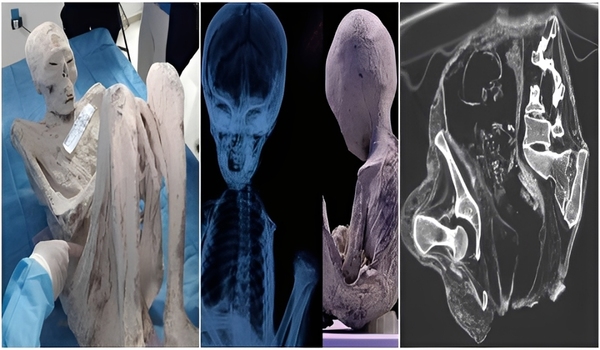
The Nazca mummies are once again in the spotlight, this time under the attentive eye of accomplished UFO researcher and broadcaster Jesse Michels. Jesse has been gaining increasing attention and recognition in the UFO field due to his serious commitment to sharing information on the subject.
He became widely known after conducting the first interview with whistleblower David Grusch last year.
Now, Jesse has sought impartial information about the true nature of the well-known and controversial Nazca mummies, and the results of his research were published in documentary form on his YouTube channel.
Since they were found in Peru and brought to the attention of journalist Jaime Maussan in 2015, the Nazca mummies have gained considerable notoriety worldwide — especially after some specimens were displayed at a public hearing in the Mexican Congress in 2023.
The specimens found possess peculiar characteristics unlike any known human, living or dead, recorded on Earth — both in their general appearance and, especially, in their hands and feet, which have only three fingers each.
Researchers state that the mummies preserve tissues, muscles, and organs. Notably, one of the specimens was pregnant, and some appear to have been killed by some type of piercing object, according to recent information. Hundreds of appendages, body parts, and intact bodies were found in a system of tunnels in Peru.
They appear to belong to an ancient humanoid “tridactyl” species — with three fingers on hands and feet — elongated, conical skulls, and rare metallic implants. Carbon dating indicates these specimens are more than a thousand years old.

Details Reinforcing the Complexity of the Nazca Mummies
One of the beings found, named Montserrat, was pregnant at the time of discovery. Surprisingly, her fetus also has three fingers on its hands and feet, indicating a true genetic inheritance between mother and child.
In addition, the bodies contain what seem to be biomedical implants made of rare metals such as osmium and cadmium. These implants are fused to the tissues through a process called osseointegration, which indicates the beings were alive when they received them. Intriguingly, these metals were only officially discovered by humans in the 19th century, while the mummies have been carbon-dated to more than a thousand years ago.
Bioinformatics researchers identified a genetic mutation in the GLI3 gene within the bodies, linked to anomalies in the number of digits in other organisms. This reinforces that the three-fingered trait is natural, not the result of artificial manipulation.
Forensic experts from three countries — the United States, Mexico, and Peru — examined the mummies and found no evidence of mutilation or fraud in the fingers. They believe these beings were once living organisms and merit further study. Among them is John McDowell, former president of the American Forensic Association.
In the local Nazca culture, numerous artistic representations — pottery, cave paintings, and woven fabrics — depict three-fingered beings, suggesting a historical tradition connected to such figures.
The region where the mummies were found corresponds to a complex tunnel system whose original name, according to a local historian, can be translated as “Laboratory for Insemination and Hybridization.”

Controversies and Next Steps
On the other hand, some researchers argue that this is an elaborate hoax involving artificial mutilations for profit or ritual reconstructions made from the parts of different animals. There are also questions about the precise provenance of the tunnels where the bodies were discovered.
Another factor causing confusion is the mistaken association between these real bodies and small wooden tourist artifacts seized by the Peruvian Ministry of Culture at Lima Airport — items that many people believe to be fakes — which has led to the discrediting of the genuine mummies that have verifiable genetic, forensic, and imaging data.
To move the investigation forward, a partnership has been established with Colossal Biosciences — known for its dire wolf de-extinction project — to apply advanced ancient DNA analysis techniques to the mummies. The only obstacle is obtaining permission from the Peruvian government to send samples to laboratories in the United States.
The goal is to conduct a transparent, rigorous scientific investigation to help solve this mystery for the benefit of humanity.
/i.s3.glbimg.com/v1/AUTH_59edd422c0c84a879bd37670ae4f538a/internal_photos/bs/2024/6/v/mUIlc4TReQdFlnMAAuDQ/000-34eq8rq.jpg)
Genetic Testing and the Hypothesis of an Unknown Subterranean Human Species
In his documentary, Jesse Michels shared his personal impression, based on months of research, about what the Nazca mummies might truly represent.
“I found no evidence that they are not from Earth,” Michels stated, suggesting the bodies could belong to a previously unknown subterranean species.
Michels pointed out that a bioinformatics specialist had analyzed the publicly available DNA and identified a genetic mutation associated with a congenital condition that causes deformities in human fingers and toes.
Bioinformatics expert Alaina Hardie explained that her initial goal was to “disprove the hypothesis” that a genetic mutation could cause such anomalies.
“I found a list of 50 genes involved in this biological pathway,” Hardie said. “There is a mutation in one of them, called GLI3, which is associated with polydactyly.”
Polydactyly — the presence of extra digits or digital malformations — has been identified in archaeological remains in Peru, indicating that this trait existed in ancient civilizations.
Genetic analysis revealed that the mummies’ DNA samples matched, for the most part, human genetic profiles, though they showed some contamination and technical challenges common to ancient DNA research.
The scientific team used advanced extraction techniques to carefully isolate genetic material from the mummies’ bone and muscle tissues. They then employed genome sequencing and bioinformatics tools to reconstruct genetic profiles and identify specific mutations.
Due to the typical degradation and fragmentation of ancient samples, researchers compared the findings with known terrestrial organisms and environmental DNA to distinguish authentic sequences from background noise.
While some DNA fragments could not be immediately identified, subsequent processing indicated that they most likely belonged to known terrestrial organisms or were compromised due to poor sample quality.
/i.s3.glbimg.com/v1/AUTH_1f551ea7087a47f39ead75f64041559a/internal_photos/bs/2023/D/V/A7K28UQl67q2slmHQaHA/blog-ostrich.jpg)
The analyzed samples included both bone and muscle tissue from a mummy known as “Victoria”, a headless humanoid specimen, which confirmed the human origin of its DNA.
Michels also drew attention to a tribe in northern Zimbabwe where a congenital condition called ectrodactyly, or “Ostrich Foot Syndrome”, is present.
This disorder results in the absence of one or more central digits, creating a V-shaped cleft or gap in the hand or foot.
“There are mutations that can become adaptive in certain environments and persist over time,” Michels explained in his documentary. “So, it could simply be that — which would be remarkable in itself.”
While polydactyly (extra digits) does not match the three-fingered configuration of the Nazca mummies, ectrodactyly aligns much more closely with their anatomy.
José Zace, head of the medical division of the Mexican Navy and a member of the research team studying the mummies, reported that the larger bodies contain 70% known DNA, while the remaining 30% is completely different from anything in current genetic databases.
Dr. David Ruiz Vela, one of the leading experts investigating the remains, has suggested that the mummies may be hybrids.
He proposed that “Maria”, one of the specimens, exhibits mixed characteristics that could be the result of natural migration and interbreeding events between different primate or human species across Asia and Africa, spanning a broad timeframe of 250,000 to 2,500 years ago.
The fact is that investigations into the Nazca mummies, involving DNA analyses, forensic examinations, and historical context, reveal a complex mystery that challenges what we know about human history. The presence of preserved tissues, the unusual anatomy with three fingers, rare metallic implants, and genetic mutations related to known conditions suggest that these beings were, at some point, alive — they could be a different human lineage, a natural variation, or something we still don’t fully understand. Moreover, various depictions in ancient Nazca artifacts indicate that these creatures may have been known to past civilizations.
Of course, there are people with legitimate skepticism, raising doubts about where these bodies came from, possible frauds, and ritual reconstructions. But the scientific interest and the multidisciplinary research show that an open, transparent, and thorough investigation is necessary. Whatever they turn out to be — hybrids, yet unidentified human relatives, or even an elaborate hoax — uncovering this mystery is what really matters.
If you want to know more about the Nazca tridactyls, visit: https://tridactyls.org/specimens
Below, watch Jesse Michels’s documentary.