


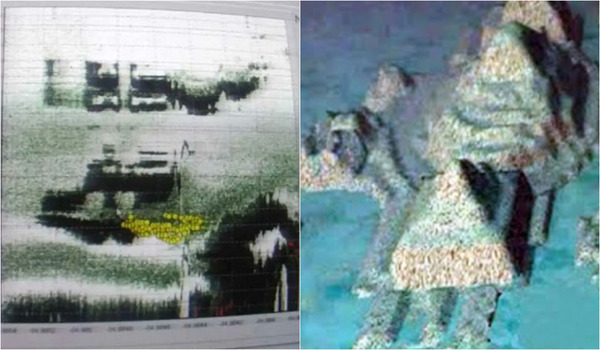
What happened to this story? In December 2001, the media went into a frenzy over reports that “explorers… had discovered what they believe are the ruins of an underwater city built thousands of years ago.”
It was a bold claim that drew attention from respected outlets like National Geographic, as well as from more fringe audiences, including Linda Moulton Howe, a well-known figure in the UFO community.
The news was welcomed by those who believe Atlantis was a real place rather than a political allegory invented by Plato. More specifically, it appealed to followers of the alleged psychic Edgar Cayce (1877–1945), who claimed that Bimini, in the Bahamas, was part of the submerged island.

What were these claims based on? In 2000, Canadian explorers Paulina Zelitzki and Paul Weinzweig, owners of Advanced Digital Communications (a company that apparently has no website), were one of four firms contracted by the Cuban government to conduct sonar surveys on the Guanahacabibes Peninsula, at the western tip of the island. The structures they reported discovering were estimated to be around 6,000 years old.
Advanced Digital Communications had already successfully located the wreck of the USS Maine, which sank under mysterious circumstances in Havana Harbor in 1898 during the Spanish–American War. They were expected to locate additional shipwrecks.
To their surprise, during the survey of the Guanahacabibes Peninsula, some sonar images appeared to show symmetrical structures arranged in a grid. This prompted them to conduct a second survey, this time using a submersible robot.
It was this second survey that returned data seemingly depicting pyramids and other structures. According to Paulina Zelitzky, the images suggested that the “city” had been built from carved and polished granite blocks.
Finally, it seemed that something had emerged that could serve as solid physical evidence for the existence of an advanced civilization at a time when sea levels were much lower (presumably during the Pleistocene Ice Age). Some of the claims circulating online included the identification of a sphinx, a Stonehenge-like structure, and even a monument identical to the “Face on Mars.” All of this was reportedly located at depths between 600 and 750 meters — an extremely deep environment.
The depth was so great that it posed a significant challenge for the team at Advanced Digital Communications, who were unable to explore the site with the level of detail needed to confirm their hypotheses.

To obtain more precise data, Paulina Zelitsky began raising funds for a third expedition to the site. The announcement was made in October 2004, in a report that appears to have received little attention from mainstream international media (though it was circulated by several spiritualist and alternative websites). However, “they were unable to complete the mission due to technical deficiencies in the submarine, which prevented it from capturing images of the seafloor.” One naturally wonders why they would proceed with insufficient equipment when they were supposedly on the verge of such an important discovery.
Even so, Zelitsky stated that they would return in 2005, this time with funding from the National Geographic Society. Since then, nothing but silence — aside from the story’s inevitable appearance on the show Ancient Aliens.
Problems, of course

The depth of the supposed remains is the most significant issue. During the Pleistocene, sea levels indeed dropped as vast amounts of water became trapped in the ice sheets that formed around the globe. At the peak of glaciation, the drop was about 100 meters — far from the 600 to 750 meters of depth associated with the alleged structures. At no point during the Ice Age would these features have been above sea level, unless the terrain beneath them had later subsided.
This, in fact, is one of the claims made about Atlantis. According to Plato — the only primary source on the subject — the island was destroyed by σεισμῶν ἐξαισίων καὶ κατακλυσμῶν (“violent earthquakes and floods”). However, if we take Plato seriously — as we must if we assume Atlantis was a historical place — the violence of its sinking makes it unlikely that an entire city could have survived a sudden drop of more than 600 meters into the abyss.
Plato also notes that this occurred μιᾶς ἡμέρας καὶ νυκτὸς χαλεπῆς (“in a single terrible day and night”) and adds that κάρτα βραχέος ἐμποδὼν ὄντος͵ ὃν ἡ νῆσος ἱζομένη παρέσχετο (“which is why the sea in that region remains impassable, obstructed by the mud just beneath the surface — the remains of the sunken island”). Such a rapid catastrophe would have devastated any structures, and the mention of mud just below the surface suggests that the collapse did not occur at depths of 600–750 meters.
Unless we are willing to dismiss Plato’s text — the sole source of the Atlantis story — we cannot identify the formations described by Paulina Zelitzky with the legendary island.

So, what happened to the story?
Although some suggested that Paulina Zelitsky’s discoveries were suppressed by the military — or that she was prevented from returning to the site — in reality, the story simply faded into obscurity.
In July of that year, researchers returned to the location with marine geologist Manuel Iturralde-Vinent from the Cuban Museum of Natural History, this time using a remotely operated vehicle (ROV) to document the formations.
The footage revealed blocks resembling granite, measuring approximately 2.4 by 3 meters. Some were stacked, as if arranged by human hands, while others were isolated.
Despite initial excitement in certain circles, including that of Manuel Iturralde, experts were not convinced that Zelitsky had truly discovered a submerged city.
Zelitsky continues to work as an oceanographic engineer in Ontario, Canada, and since 2004 she has announced no plans to revisit the site. Although some interpret this as evidence that she was discouraged or silenced, it is far more likely that she was unable to secure funding for an expedition in search of something that may not exist at all.
The story regained some visibility thanks to its appearance on the show Ancient Aliens, but no new information has emerged. After the initial excitement, once scientists began to critically analyze the data — especially the sonar images — the story came to be viewed more as sensationalism. Was this the result of intentional suppression, or simply because the evidence pointed in that direction? Well, we don’t know.