


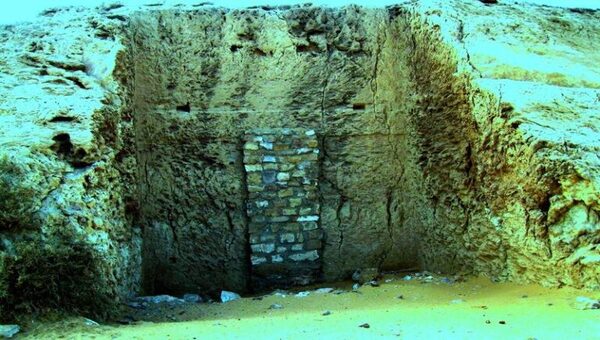
The Giza Plateau is once again at the center of major controversy following a drastic and unexpected measure. Richard Gabriel, a researcher who has spent decades documenting the enigmatic underground NC2 system, confirmed that Egyptian authorities have permanently sealed the entrance with stone blocks and cement.
The definitive closure of important archaeological sites such as the “Tomb of the Birds” and the “Serpent Cave” would be — according to Gabriel himself — a direct reaction to the release of his recent research and documentaries, which exposed the connection of these tunnels to much deeper levels beneath the sand.
In this regard, it is almost certain that the revelations made by Italian scientists from the Khafre Research Project also contributed, whose radar tomography (SAR) scans reportedly confirmed in 2025 that the NC2 system connects to massive structural spaces extending for miles underground — a network that authorities have allegedly refused to make officially public.

Allegations of Looting and Historical Manipulation
The significance of this complex lies not only in its size, but also in the value of the objects it allegedly housed. Gabriel claims that, before the definitive sealing, teams operating under the authority of Zahi Hawass removed documented artifacts and deliberately damaged unique pieces, such as stone altars and thrones, presumably to diminish the archaeological value of the site and justify its closure.
This controversial management was portrayed in the television series Chasing Mummies, where Hawass himself appeared to dismiss ancient illustrations visible on the rocks, while members of his team stated on camera that the system offered nothing of value.
However, Gabriel asserts that he possesses hundreds of dated, time-stamped photographs that contradict this official version, allegedly proving that the vandalism was a prelude to the complete silencing of the complex.
It is worth noting that this pattern of secrecy coincides with growing criticism from Italian scientists, who question why authorities are restricting scientific access precisely at a time when modern technology from their project reportedly detects large-scale infrastructure beneath the Giza Plateau.

Therefore, according to Gabriel, the use of cement is nothing more than a definitive physical barrier intended to prevent independent analysis from confirming the existence of this alleged subterranean city.
A Legacy That Challenges Official
DoctrineBeyond its architecture, the NC2 system reportedly exhibited disturbing anomalies, including vibrations said to produce physiological effects on intruders, as well as illustrations depicting pyramids set in jungle environments alongside strange “light poles.”
Likewise, the alleged discovery of ancient Ogham inscriptions at the site suggests, in this narrative, that the Giza Plateau functioned as a repository of technology from a pre-cataclysmic era — a claim that stands in direct contradiction to mainstream academic history.
In light of this scenario, Gabriel believes that the ultimate objective is to erase any physical evidence that could force a rewriting of textbooks and to maintain exclusive control over an ancient technological legacy.
For this reason, the researcher argues that the closure is intended to bury decades of discoveries beneath concrete blocks, allowing the alleged reality to fade into obscurity.
“The suspicion is clear: they are trying to turn a tangible discovery into a mere myth, keeping under exclusive and hermetic control the possible evidence of an advanced ancient technology that would compel a rewriting of human history,” he concluded.