


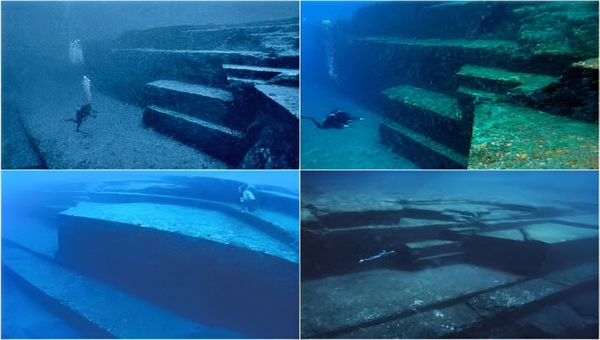
Just 25 meters below the crystal-clear waters surrounding Japan’s Yonaguni Island lies a spectacle that challenges the boundaries of conventional archaeology.
A massive sandstone structure measuring 100 meters by 40 meters and standing about 25 meters tall rises in perfect, giant steps, with straight edges and ramps that look like they were taken from a model of an ancient city. Could it be the ruin of an unknown civilization? Or simply an extraordinary rock formation?
The discovery became known as the “Japanese Atlantis.”
The site was first found in 1986, when diving instructor Kihachiro Aratake was exploring the area—located about 100 kilometers east of Taiwan—in search of new underwater attractions for tourists.
As he approached, he encountered gigantic stone structures that immediately reminded him of archaeological constructions.
Surprised, Aratake alerted researchers at the University of the Ryukyus, marking the beginning of the legend of the “Japanese Atlantis,” in reference to the island mentioned in Plato’s works.
/i.s3.glbimg.com/v1/AUTH_59edd422c0c84a879bd37670ae4f538a/internal_photos/bs/2021/z/n/jJPN91QBywwzUSmMpGEQ/bbc.png)
One of the main proponents of the human-origin hypothesis is Masaaki Kimura, emeritus professor of geophysics at the University of the Ryukyus, who has spent decades studying the site.
Kimura has no doubts: to him, what lies beneath the sea are the remains of an ancient city, possibly built by the Jōmon people more than 10,000 years ago, when the region was still above sea level due to lower sea levels at the time.
Later, Kimura revised his estimate to somewhere between 2,000 and 3,000 years old, according to the science website IFL Science.
“I immediately thought of pyramids and felt like I was in ancient Egypt,” said the professor in a documentary cited by the German newspaper Süddeutsche Zeitung in 2017.
As evidence of its artificial origin, Kimura claims to have identified marks on the stones and rocks that appear to have been carved into the shapes of animals.
“One example I described as an underwater sphinx resembles a Chinese king or an ancient Okinawan ruler,” he told National Geographic in 2007.
For Kimura, there are two key pieces of evidence: on one hand, markings that could indicate quarrying work and carved figures; on the other, the region’s intense seismic activity.
In an interview with the Japanese newspaper Yomiuri Shimbun, he recalled that in 1771, a tsunami with waves as high as 40 meters devastated Yonaguni Island, causing around 12,000 deaths. According to Kimura, it’s not unthinkable that a similar event could have submerged an entire city.
His theory is supported by other experts, such as Toru Ouchi, associate professor of seismology at Kobe University, who has personally dived at the site.
“What Professor Kimura says is not exaggerated at all. It’s easy to see that those relics weren’t caused by earthquakes,” he argues.
/i.s3.glbimg.com/v1/AUTH_59edd422c0c84a879bd37670ae4f538a/internal_photos/bs/2025/O/F/oRriWhRhOb8S35tPKA4Q/72568911-906.jpg)
However, the theory is not unanimous. Robert Schoch, a professor at Boston University and a geologist, stands on the opposite end of the debate. After his first dive at the site, he argued that the formation is not artificial.
“It’s not as regular as many claim, and the right angles and symmetry don’t hold up in several places.”
According to Schoch, the formations are the result of natural geological processes. “It’s basic geology and classic sandstone stratigraphy, which tends to break along planes, creating these very straight edges—especially in an area with many faults and tectonic activity,” he explained to National Geographic.
In an article for the German newspaper Spiegel Online, geologist and professional diver Wolf Wichmann agreed with this view after analyzing the site multiple times, noting that the walls of the rock blocks follow natural erosion patterns.
“The surfaces and walls follow the predetermined weak zones in the rock: the joints between layers of sedimentary rock and the network of fractures that run perpendicular to them,” he wrote.
Wichmann explained that features such as “ripple channels, holes carved out by the force of water, hardened crusts, as well as holes made by sea urchins and shells” are clearly identifiable as natural formations.
One of the strongest arguments against the lost civilization theory involves chronology. As highlighted by IFL Science, if the monument were artificial, it would have had to be built before it became submerged—meaning more than 12,000 years ago.
This would place it earlier than any other known sophisticated civilization, even predating Göbekli Tepe, the oldest monumental temple ever discovered, which would challenge current understanding of the rise of complex human societies.
Moreover, the current scientific consensus holds that large monumental constructions only emerged after the development of agriculture (around 12,000 years ago), which allowed for food surpluses, centralized power structures, and labor specialization.
If it were proven that Yonaguni is artificial, “it would require completely rewriting history,” as noted in a report by the Indian news outlet NDTV.
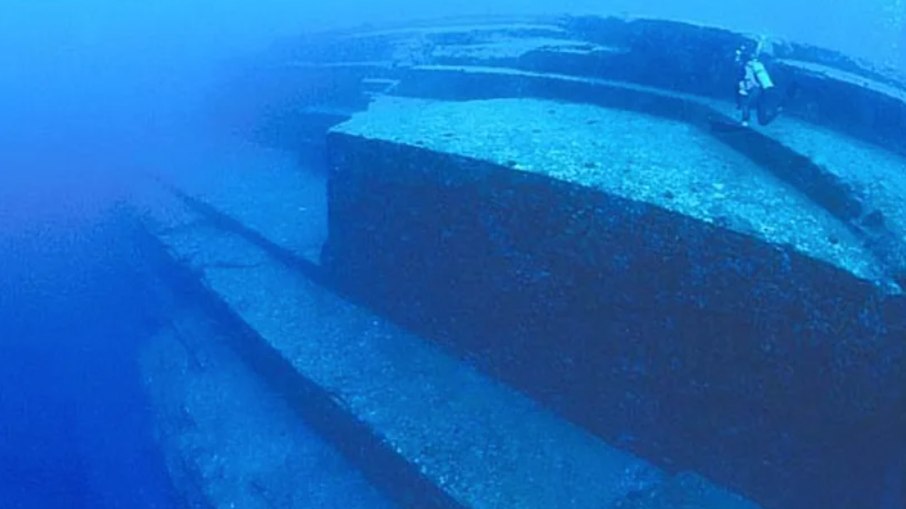
Despite the narrow corridors, arched entrances, and seemingly parallel 90-degree angles found underwater at Yonaguni, there is not enough evidence to indicate that the rocks were carved by human hands.
Some proponents who argue otherwise go even further, claiming the formation is linked to the legendary lost continent of Lemuria (also known as the continent of Mu, similar to Atlantis) in the Pacific.
However, there is no scientific evidence that Lemuria ever existed. The hypothesis, which emerged in the 19th century, was an attempt to explain the distribution patterns of species across continents—at a time before the scientific understanding of plate tectonics.
According to Japanese geoscientist Takayuki Ogata, also from the University of the Ryukyus, all signs point to a natural formation—especially when considering similar rock formations in the surrounding area, as well as the fact that the structure is connected to a larger rock mass, suggesting that the well-defined layers gradually formed due to its location in an earthquake-prone region.
Beyond the debate, what is certain is that the Yonaguni Monument has become a popular destination for adventurous divers, although it is not without risks due to the region’s strong currents. In addition to its archaeological and geological interest, the site is home to rich biodiversity, including hammerhead sharks.