




They no longer need to draw the impossible. Now it’s enough to ask AI to show it. And it does. In documentary-style videos, with smooth cuts, imaginary drones, and epic soundtracks, scenes appear that once only lived in conspiracy forums and footnotes: an ice wall in Antarctica, reptilians escaping from underground, ships hovering over cities, hidden pyramids in the Amazon, Noah’s Ark intact, giants building civilizations. All with the look of reality. All with cutting-edge technology.
For years, what kept these stories from gaining traction was the aesthetic. Even conspiracy theorists themselves complained that their videos were always low resolution. The joke was automatic: “with so much technology in the world, no one films a flying saucer in HD?”. That has changed. With tools like Veo 3, Google’s new AI video generator, anyone can turn delusions into cinematic-quality video. Just type: “create a realistic video of a NASA plane flying over alien statues in Ratanabá,” and the video appears. In seconds. With light, shadow, paced narration, and everything a viral post needs. AI doesn’t create evidence. It creates the evidence needed for existing convictions.
No studio, camera, or script is needed anymore. Just good WiFi, an AI platform account, and a bit of conspiratorial creativity. What once required faith now has pixels. And what was once dismissed as fantasy today gains likes, monetization, and followers. We are witnessing, in real time, the professionalization of conspiracy. And it comes well-edited, rendered, and optimized to engage—with a deep voice, cinematic background, and ALL CAPS subtitles. But after all, among so much content, how exactly are AI-generated videos turbocharging conspiracy theories?
1. Reptilians
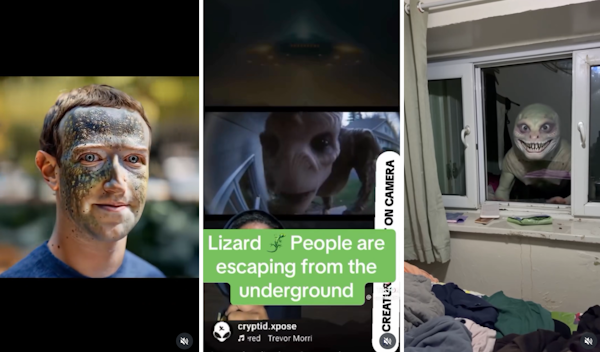
The conspiracy theory that has dominated for at least a decade the imagination of many U.S. citizens is now spreading worldwide. The most-shared reptilian videos simulate scenes of humanoid, scaly-skinned creatures emerging from tunnels or underground areas, as if returning to the surface after centuries in hiding. In another version, the video focuses on an interview with Mark Zuckerberg, but as the camera zooms in, his face slowly morphs into a reptile—with vertical eyes and textured skin. All of this is deepfake, with smooth transitions, realistic lighting, and cuts that mimic journalistic language. In the comments, some laugh. Others call it “irrefutable proof,” “waking up from the matrix,” and “system collapse.”
2. Aliens (UFOs)
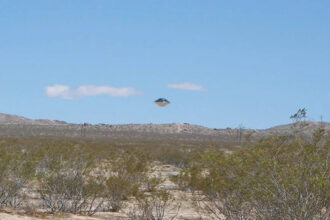
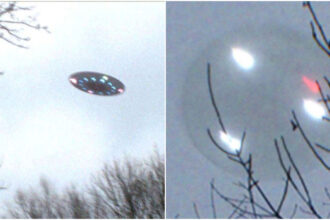
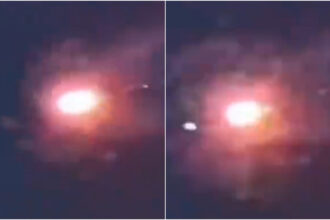
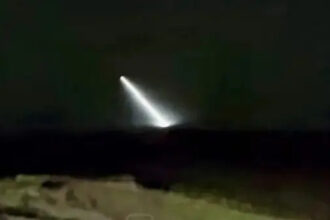
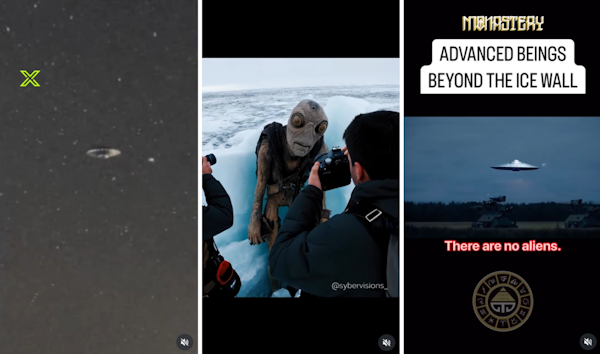
AI-generated alien ship videos have become routine in conspiracy groups, even leading to fact-checking reports worldwide with warnings about them. The style varies. Some show flying saucers over urban areas, “accidentally” filmed by cell phones, while others display flashing lights in the sky with erratic movements and deep, distorted sounds. In some, ships land in deserted fields, always with a supposed “witness” shaking the camera in the best found footage style. Some even show supposed aliens up close. And commenters swear that “this time it’s real.”
3. Ice Wall
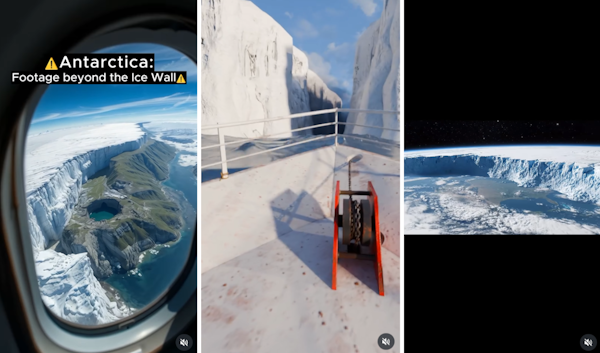
For flat-earth conspiracy followers, the idea of an “ice wall” circling the planet has already been debunked for years. But with AI, ice walls have become visually more sophisticated. They simulate flyovers across vast polar regions until massive frozen cliffs appear—supposedly the boundary of Antarctica and Earth itself. In some versions, humans are inserted walking nearby to show “real proportion.” In others, a secret entrance is revealed, with glowing caves and unexplored landscapes just beyond the ice. Some videos even show gold, pyramids, and civilizations hidden on the other side. AI delivers whatever the imagination requests. And the illusion, in this case, comes in 4K.
4. Secret Pyramids
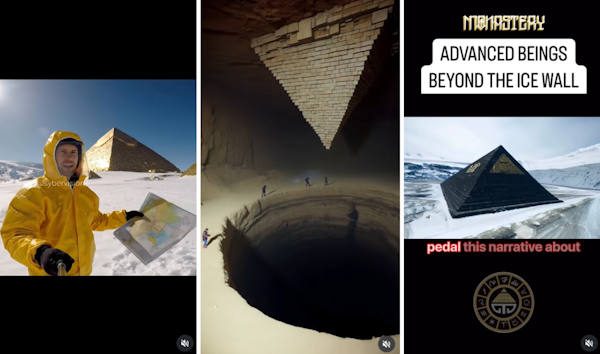
Desert landscapes, mystical soundtracks, and drones flying over geometric structures. Ideas about secret pyramids or even underground cities powered by supposed pyramid energy resurface from time to time and are debunked by experts. AI-generated secret pyramid videos simulate discoveries that “official archaeology” allegedly hid from humanity. There are underground pyramids with sealed entrances and others that glow when “energized” by aliens. In many cases, robotic narrations talk about “universal frequencies,” “planetary energy lines,” and “suppressed ancient wisdom.” The visuals impress with realistic textures, paced voices, and dramatic close-ups.
5. Ratanabá
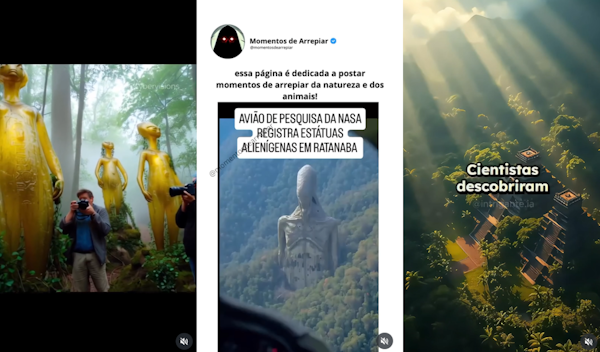
The theory of a lost city in the Amazon gained momentum with the help of AI. Videos show giant golden statues hidden beneath dense trees, digital maps, and drones flying over temple ruins covered by vegetation. In one version, a supposed NASA aircraft flies over the region and captures images of humanoid stone carvings—all AI-generated. The videos use dramatic angles extensively. The name Ratanabá is highlighted as if it were an ancient civilization rediscovered. In the conspiracist imagination, it is a digital El Dorado.
6. Noah’s Ark
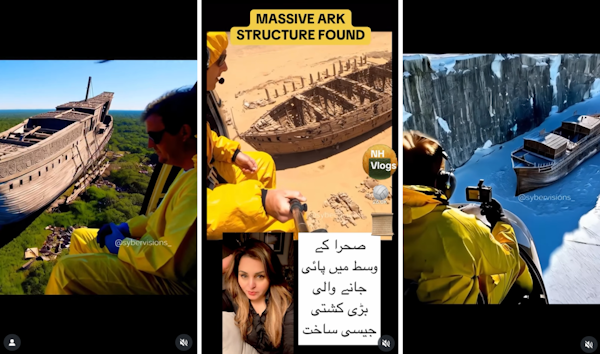
Often, archaeologists organize expeditions to find what could be the so-called “Noah’s Ark.” Without success in the physical world, some conspiracy theorists turned to imagining it digitally. In documentary style, videos simulating the discovery of Noah’s Ark show a massive structure trapped in mountains, deserts, or even glaciers. In another version, a research team wearing lab coats with fake university logos explores the ship’s interior. AI recreates dried wood, measuring instruments, and even muffled dialogue between “researchers.” The staging is perfect for those already seeking confirmation of religious beliefs. And for those who aren’t, it’s convincing enough to spark doubt.
7. Giants
Perhaps the most mythological of all, videos about giants mix archaeology with fantasy. For years, images have been manipulated to supposedly show giant skeletons in nature. With AI in the picture, we now see realistic scenes of six-meter-tall humanoids dragging stones and building the pyramids of Egypt—with fluidity, proper shadows, and epic atmosphere. In other versions, giant skeletons are found in excavations, with tiny humans nearby for scale. Though it may seem absurd, these videos often push closer to reality, showing giants about three meters tall, resembling lost and newly revealed footage. The videos simulate old news reports, dusty newspapers, and even supposed secret government archives. It’s the myth of Goliath, now rendered in real time for millions to believe.
To Render Is to Persuade
The issue here is not just the content. It’s the form. The aesthetics of lies have become professional. When a video has proper lighting, clean framing, paced narration, and dramatic close-ups, it already looks true. AI doesn’t just produce images. It produces the feeling that something is being revealed. And when a lie is packaged like a documentary, the effect is not just confusion. It is building certainties that resist any attempt at debunking.
This inaugurates a new phase of conspiracy theories. In the past, they spread through text, audio, obscure forums, or suspiciously edited videos. Today, they come rendered in 4K, with the language of science communication, storytelling rhythm, and investigative journalism aesthetics. Instead of hiding, the narrative of revelation now presents itself with authority. And what was once marginal now takes center stage in the feeds of millions, boosted by algorithms that reward engagement, not truth.
This is not nostalgia for a time when everything was more believable, but a real urgency: either society learns to recognize the logic of simulations, or we will live in a war of versions that look like facts. The challenge now is ethical, educational, and political. Because it’s not just science at stake. It’s the very idea of shared reality. Otherwise, are we really going to accept that the next viral “truth” will be decided by a prompt?
Ergon Cugler, Master in Public Administration and Government, and researcher for the national strategy against disinformation, Fundação Getúlio Vargas (FGV) and Camila Modanez, Graduate Student in Strategy and Political Leadership, University of Campinas (Unicamp)
This article is republished from The Conversation under a Creative Commons license. Read the original article.