


The Veerabhadra Temple, located in Lepakshi, in the Indian state of Andhra Pradesh, is a remarkable example of Vijayanagara architecture and Hindu religious tradition. Dedicated to Veerabhadra, a fierce form of the god Shiva, the temple combines architectural beauty, detailed sculptures, and murals depicting mythological stories, creating a space of devotion and historical fascination.
Built in the 16th century, the temple features typical Vijayanagara-style elements, with sculptures and paintings covering almost all exposed surfaces. It is one of the centrally protected national monuments and is considered one of the most spectacular Vijayanagara temples.
The fresco paintings stand out for their intricate details, vibrant colors, and depictions of scenes featuring Rama and Krishna from the epics Ramayana, Mahabharata, and the Puranas, remaining exceptionally well-preserved. They impress with their attention to detail in clothing, expressions, and gestures, showcasing the artistic sophistication of the period.

The temple was constructed on the southern side of the town of Lepakshi, atop a low hill made of a large granite rock, known as Kurma Saila, due to its turtle-like shape.
Fica a 140 quilômetros de Bangalore e é acessível pela Rodovia Nacional NH7 em direção a Hyderabad, com uma estrada secundária na fronteira entre Karnataka e Andhra Pradesh, a apenas 12 quilômetros de Lepakshi. Outra rota passa por Hindupur, e o templo fica a 35 quilômetros de Penukonda, no distrito de Anantapur.
The temple’s architecture reveals impressive details, such as the sculptures of Brahma and Vishnu on the pillars of the Manadapa. Each pillar tells mythological stories, giving the space both a spiritual and educational character.

The ceiling paintings of the Muka Mantapa are also remarkable. They intricately depict divine and mythological scenes using vivid colors and complex compositions that draw the visitor’s eye to every detail.
Another fascinating feature is the seven-headed hooded serpent shading the Lingam sculpture, symbolizing protection and spiritual energy. This demonstrates the integration of religious symbolism and architectural artistry.
A particularly unique aspect of the temple is the suspended pillar, known as the Akasha Sthamba. One of the 70 pillars, it hangs near the edge and does not fully rest on the floor. There is a small gap between the temple floor and the base of the pillar, allowing thin objects, like a sheet of paper or a piece of cloth, to pass through.

However, the pillar is slightly displaced from its original position. During the British period, an engineer attempted to move it to understand its technical marvel, only to find in frustration that moving it caused the adjacent pillars to shift, maintaining the overall balance of the structure.
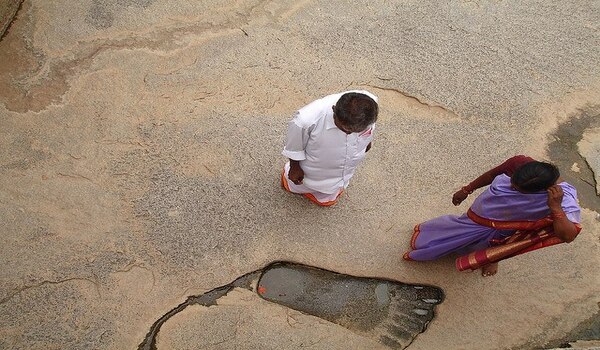
Among the many wonders of the temple, one of the most intriguing is the giant footprint of Sita. Located on a rock near the Kalyan Mantapa, it is believed to have been left by the goddess Sita, wife of Rama, during her abduction by Ravana.
Sita is a central figure in the Hindu epic Ramayana, known for her beauty, virtue, and devotion. According to tradition, during her journey through southern India, Sita passed through Lepakshi, and the footprint on the temple rock serves as physical evidence of her presence.
For devotees, the mark symbolizes Sita’s strength, faith, and resilience, connecting the mythical narrative to the sacred reality of the temple. The footprint reinforces the link between myth and physical space, making the temple a site of profound spiritual significance.
Some versions also suggest that Hanuman, Rama’s messenger, may have left marks related to the search and rescue of Sita, further enhancing the religious and cultural importance of the site, making it a destination for pilgrimage and historical study.

One of the most fascinating aspects of the Sita footprint at the Veerabhadra Temple in Lepakshi is that it remains mysteriously wet at all times. Despite the dry climate of the region, the mark on the rock never fully dries. Even when visitors try to wipe it, water seems to reappear, as if it is constantly being replenished from beneath. This intriguing phenomenon has no clear scientific explanation, as there is no visible source of water nearby.
According to local tradition, this continuous moisture is seen as a sign of divine reverence for Sita. It is believed that the water emerging from the footprint symbolizes the purity and sanctity of the goddess, reflecting her strength and devotion. Even if the water is removed, it mysteriously returns, reinforcing the belief that Sita’s spiritual presence remains alive at the site.
This enduring mystery draws both devotees and tourists, who are captivated by the footprint and its constant moisture.

The scientific explanation for the formation of the footprint attributed to Goddess Sita at the Veerabhadra Temple in Lepakshi is related to the natural erosion of the rock. Over time, the action of natural agents such as wind, water, and temperature variations can wear away the stone surface, creating grooves and depressions. In the case of this footprint, it is believed that the combination of these factors resulted in the impression that is visible today.
Regarding the constant presence of water in the footprint, the scientific explanation involves the capillarity of the rock. Lepakshi is situated on a hill with extensive granite exposure, known as Kurma Saila. Groundwater can rise through the pores of the rock by capillary action, keeping the surface of the footprint moist even during dry periods. This phenomenon is observed in various rock formations and provides a plausible explanation for the constant moisture in the footprint.

Although these scientific explanations provide an understanding of the phenomenon, they do not diminish the cultural and spiritual significance of the footprint for devotees. For many, the footprint remains a symbol of devotion and a tangible connection to the mythological stories associated with the Veerabhadra Temple.