



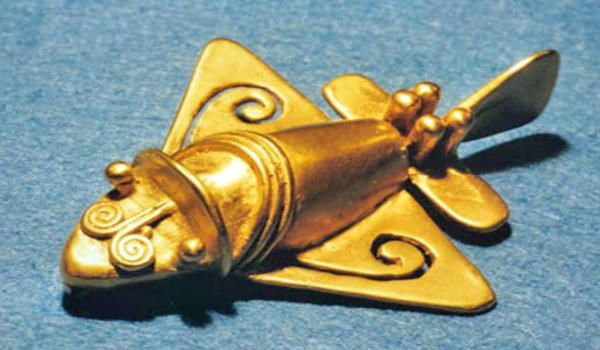
The Quimbaya civilization, an ancient indigenous culture that inhabited what is now Colombia, thrived in the fertile valleys of the Cauca River, covering the modern departments of Quindío, Caldas, and Risaralda. Known for their complex ceremonial practices, this society reached its peak between the 4th and 10th centuries, leaving an impressive legacy of art and cultural wealth.
Although the exact origins of the Quimbaya people are not fully known, archaeological evidence suggests they settled around the 1st century B.C. During their classical period, they developed a highly organized political system structured in chiefdoms, with specialized groups dedicated to trade, warfare, ceramics, religious practices, and especially goldsmithing.
The temperate tropical climate of the Cauca valleys allowed the Quimbaya to cultivate maize, cassava, avocados, and guavas, while supplementing their diet with hunting deer, armadillos, and peccaries. Textile production, particularly cotton blankets, was significant, as was salt extraction using innovative techniques, which they traded alongside gold and textiles. This trade network highlights the Quimbaya’s skill as both artisans and merchants.

Among their creations, ceramics included pots, vases, and figurines, often anthropomorphic or zoomorphic, representing social classes or specific individuals. These objects were frequently buried with the deceased, along with food, weapons, and gold, reflecting their belief in an afterlife. Additionally, rock sculptures, such as those found in the Las Piedras Marcadas Natural Park, display spirals, stars, and other celestial symbols, indicating a deep connection to the spiritual world, though their exact meaning remains unknown.
Funerary rituals were central to Quimbaya culture. The dead were buried in hollowed wooden sarcophagi, accompanied by gold, food, and personal items, symbolizing a carefully prepared journey into the afterlife. Gold held a sacred role, representing spiritual elevation and social status. By the 10th century, the Quimbaya culture disappeared, possibly due to migration, climate change, or social conflicts. Yet their artistic and technological achievements remain a cornerstone of Colombia’s pre-Columbian heritage and are celebrated in museums worldwide.
Among the most fascinating legacies of this civilization are their gold artifacts, created between the 3rd and 10th centuries using tumbaga, a gold-copper alloy, with sophisticated techniques such as lost-wax casting. Among these pieces are the Poporos, ceremonial containers for coca leaves, decorated with human and animal motifs.

Beyond these well-known objects, some stylized pieces stand out for their aerodynamic and unusual shapes: the so-called “Quimbaya airplanes.” These artifacts feature tails, wings, and elongated fuselages that resemble modern aircraft. While their exact function was symbolic or ritualistic, these pieces impress with their advanced design and continue to inspire mystery and fascination today.
These artifacts were primarily discovered in tombs and archaeological sites during the 20th century as part of the so-called Quimbaya Treasure, which included thousands of gold, ceramic, and other ritual objects. The “airplanes” are generally between 5 and 7.5 centimeters long and were found alongside funerary offerings, indicating that they had symbolic or spiritual purposes, possibly related to the afterlife.
The design of these pieces is particularly intriguing: their elongated shapes, with vertical tails, horizontal wings, and conical fuselages, resemble the silhouette of modern airplanes or jet-type aircraft. Modern researchers who tested scale models of these artifacts found that they could actually glide, suggesting that the Quimbaya had an empirical understanding of aerodynamics, even without formal scientific knowledge.
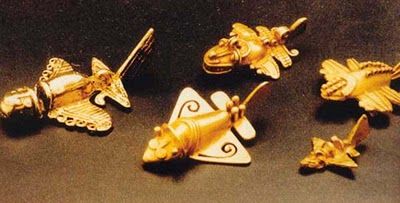
Despite the resemblance to modern aircraft, there is no evidence that the Quimbaya culture had any flying technology. The most accepted interpretation is that these objects served symbolic or ritual purposes, representing spiritual beings, divine messengers, sacred animals, or concepts of movement and ascension used to accompany the dead into the afterlife.
The “aviation-like” aspect of these artifacts likely combines artistic stylization and technical skill, demonstrating the mastery of Quimbaya goldsmiths in creating sophisticated forms that impressed not only for their material value but also for their symbolism and ingenious design. Today, these pieces continue to be studied and displayed in museums, including the Gold Museum (Museo del Oro) in Bogotá, Colombia, captivating both for their cultural significance and the mystery of their aerodynamic forms.
In 1994, the Germans Peter Belting and Conrad Lubbers created simplified scale models of these objects and demonstrated that their models, which lacked some of the more complex features of the real figures, could actually fly, reinforcing the mystery and curiosity surrounding the implicit technical knowledge in these small gold works.