


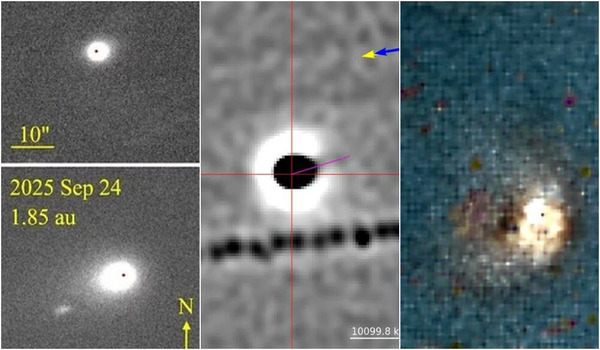
3I/ATLAS has reversed its jet direction, shifting from an anti-tail pointing toward the Sun to a conventional tail streaming away from it, according to recent observations captured by the Nordic Optical Telescope in the Canary Islands. Harvard astrophysicist Dr.
Avi Loeb and his team have released their analysis of this unusual transition, which occurred between July and September 2025. As Loeb explains in his article the object displayed an anti-tail “pointed towards the sun, opposite to what we see in the context of comets, and now changing direction and going away from the sun the more conventional way.”
According to the model published by Loeb and researcher Eric Keto, this change results from intense surface heating as 3I/ATLAS approaches the Sun, causing frozen carbon dioxide to sublimate directly into gas.
This process carries water ice fragments with it, creating the visible glow. At distances of three to four times Earth’s distance from the Sun, water ice fragments dominate the scattering signal, but closer in, longer-lasting dust particles take over, forming the conventional tail now observed.
However, Adam Hibberd, a colleague of Loeb, has raised an alternative explanation that changes the conversation entirely. If 3I/ATLAS is an engineered spacecraft attempting to slow down, this transition from anti-tail to tail near perihelion would represent exactly what one would expect from a shift between braking thrust and forward propulsion, what researchers call a technosignature.

The object exhibits eight documented anomalies that set it apart from any previously observed interstellar visitor. As Loeb stated on Fox News, 3I/ATLAS is “at least 1,000 times more massive than previous interstellar objects” and travels within the plane of the planets around the Sun, with only a 1 in 500 chance of random alignment.
The composition shows only 4 percent water, extremely low for a comet, and displays a nickel-to-iron ratio that “we only find in industrially produced nickel alloys.” Additionally, the object arrived from the same direction as the famous Wow Signal detected in 1977, which has never been explained.
On October 29, 2025, 3I/ATLAS reached perihelion at 203 million kilometers from the Sun, positioned directly behind the Sun from Earth’s perspective and completely unobservable. This timing coincides with the optimal window for what spaceflight engineers call the Oberth effect, when a spacecraft moving at peak velocity near a massive object can most efficiently change its trajectory.
“If it was trying to avoid us noticing that it releases mini probes or doing some maneuver, that would be the perfect timing,” Loeb noted, adding that this is when an engine thrust “in the direction of motion” gains “the biggest amount of kinetic energy.”

The International Asteroid Warning Network, an organization associated with the United Nations, has mobilized a coordinated global observation campaign between November 27 and January 27, 2026. The European Space Agency’s JUICE spacecraft observed the object on November 4, 2025, and NASA’s Juno spacecraft will observe it during a Jupiter flyby on March 16, 2026.
According to Loeb, by January we should have a good idea about the nature of the object. The comprehensive data set from this campaign will provide the most detailed information ever collected on an interstellar visitor, potentially answering whether 3I/ATLAS is a natural comet or something far more unusual.
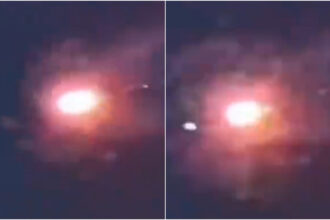
On October 20, the YouTube and amateur astronomer “Dobsonian Power” shared an image captured with his telescope on his channel and X account, and what it shows definitely shocked those who saw it.
Unlike research organizations like NASA, what we see in the image is something unusual: 3I/ATLAS appears to be spherical and solid, like something technological and manufactured.
3I/ATLAS today with my solar telescope, the only way to point so close to the Sun right now. Exact NASA coordinates at 2025-Oct-20 16:00 13 48 57.33 -08 25 54.3. It looks like a front heated shield (the jet) towards the Sun and also a faint extended puff like a small cone… pic.twitter.com/XPQHnUs3O4
— Dobsonian Power (@DobsonianPower) October 20, 2025Soon, users took the image and enhanced it, and the results are truly impressive.
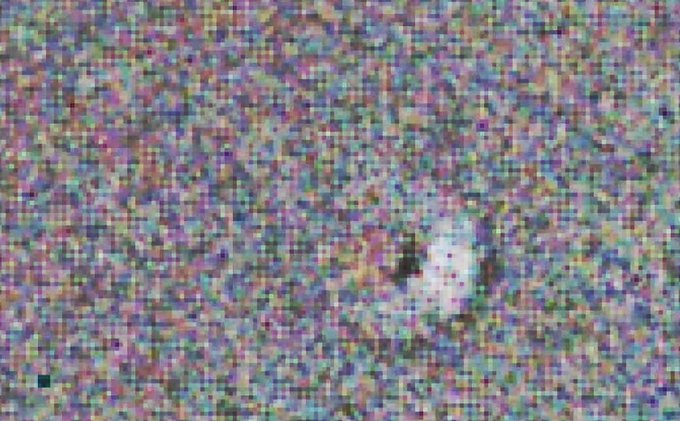


Given the evidence, it becomes impossible to deny that something truly unusual from outside the solar system is visiting us. All the anomalies presented by 3I/ATLAS, along with what appears to be its true appearance, raise questions about what we are facing—whether a truly unique celestial body or something even more enigmatic, like a technological spacecraft.
Indeed, empirically, we still do not know. Further observations, along with better data collection, are necessary, as is the effort of amateur astronomers worldwide, as exemplified by Dobsonian Power, to truly uncover the true nature of this controversial interstellar object.
Below, watch the video of the moment when Dobsonian Power records 3I/ATLAS and is surprised by what he captures.