


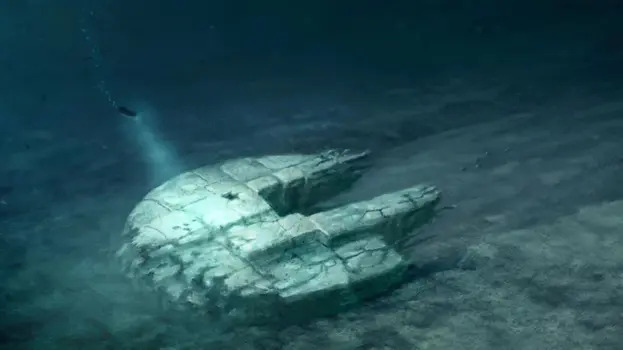
Everything began as a routine treasure hunt. On June 19, 2011, the Swedish team Ocean X, led by Dennis Asberg, was scanning the bottom of the Baltic Sea in search of shipwrecks that might contain vintage champagne. However, what appeared on their sonar was not a ship, but something that would change their lives forever.
At a depth of 90 meters, they detected a circular structure measuring 60 meters in diameter. “It was something huge… almost 3,000 square meters,” Asberg recalled about the moment they saw that strange shape on the screen, unlike any natural formation.
Almost 15 years later, the mystery—far from being solved—has only intensified. In a recent interview with Jesse Michels, Asberg revealed new data obtained around 2025 using sub-surface profilers. This technology allowed scientists to see what lies beneath the object, leading to a surprising conclusion: the structure is not a geological protrusion.
“Apparently, it is separated from the seafloor in the data,” he confirmed. According to the Swedish explorer, the images show that the object rests on the seafloor as an independent body, ruling out the possibility that it is part of the bedrock.

But the visual aspect is only the beginning. Divers who went down to the site, such as veteran Stefan Hogborn, experienced inexplicable physical phenomena. The most alarming was a localized thermal anomaly.
At that depth, the water maintains a constant temperature between 4 and 5 degrees Celsius. However, as they approached the object, the thermometers plummeted. “Now it’s almost zero. That, you know, is not possible,” Asberg explained about the freezing cold surrounding the structure.
Furthermore, the object appears to be active. The cameras captured a hole about two meters in diameter from which a milky substance or a cloud of sediment was rhythmically flowing in and out. “As if something was moving. Breathing. Almost like a biological organism,” the treasure hunter reported.
On the surface of the object, described as hard and dark, intriguing samples were recovered. Analysis revealed organic material showing signs of having been burned at high temperatures. Basalt stones were also found — a volcanic rock that, according to geologists, should not naturally occur in that area of the Baltic Sea.
Technology Not Used and Military Harassment
Perhaps the most persistent evidence of the site’s strangeness is the electromagnetic interference. Since day one, electronic equipment has consistently malfunctioned when positioned directly above the anomaly. “It’s something that makes our instruments go crazy sometimes,” Asberg said.
The reports are consistent: loss of GPS signal, lights shutting off, and underwater drones (ROVs) disconnecting. Even university research vessels equipped with modern technology have lost their navigation systems and compasses when attempting to map the area recently.
This behavior has attracted unwanted attention. Asberg claims to have video evidence of NATO ships — including American, British, and German vessels — surrounding his expedition in international waters.
In one tense incident, a Swedish Navy corvette even blocked his ship’s passage. Although military officers later denied any knowledge of the matter in private meetings, the explorer was categorical: “I told them, ‘I know you were there. I filmed you.'”

What exactly is the anomaly?
Given the evidence that the object is “separated from the seabed” and emits interference, theories have become polarized. The first hypothesis suggests it could be an accidental artificial object, possibly a UFO or secret technology, capable of generating fields that affect electronic devices.
The second theory proposes that it could be a monumental construction built by a lost civilization before the last Ice Age, more than 12,000 years ago, when sea levels were lower and the area was dry land.
Asberg rules out simple explanations such as a meteorite, due to the absence of an impact crater, or a volcano, because of the area’s geology. His immediate goal is to carry out drilling to obtain a definitive answer.
“I want to know the truth,” he concluded. “Even if it’s just a rock, I want it to come to light. But with all the information we have now… it can’t be a volcano.”
Below, watch the interview of Dennis Asberg with Jesse Michels.