


For decades, the elongated skulls found on the Paracas Peninsula, on the southern coast of Peru, have been one of those subjects that walk the fine line between academic archaeology and the murky terrain of sensationalism. However, a preliminary genetic analysis of one of these skulls has reignited the debate with a claim that is as disturbing as it is delicate: certain DNA fragments do not appear to fit into any known human lineage.
“Whatever the origin of the sample labeled as 3A, it contained mtDNA (mitochondrial DNA) with mutations unknown in any human, primate, or animal known to date (…) This is a new human-like creature, but very distant from Homo sapiens, Neanderthals, and Denisovans,” stated Brian Foerster.
In an interview with Ancient Origins, a website specializing in alternative archaeology — which it should be emphasized from the outset is neither a peer-reviewed scientific journal nor a conspiracy theory blog — this independent researcher and science communicator revealed that the genetic analysis was conducted by an American geneticist with a PhD, who also works as a consultant for the U.S. government.
The researcher’s name and institution were not disclosed, a decision Foerster justifies by citing the early stage of the study and the need to replicate the results before making them public. From a scientific perspective, this caution is understandable… although it is also, inevitably, a methodological weakness.
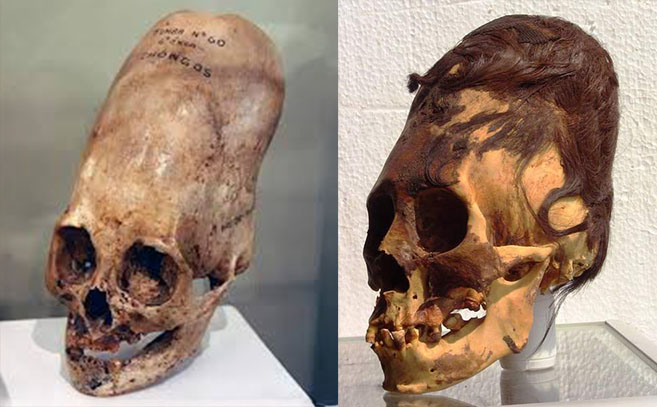
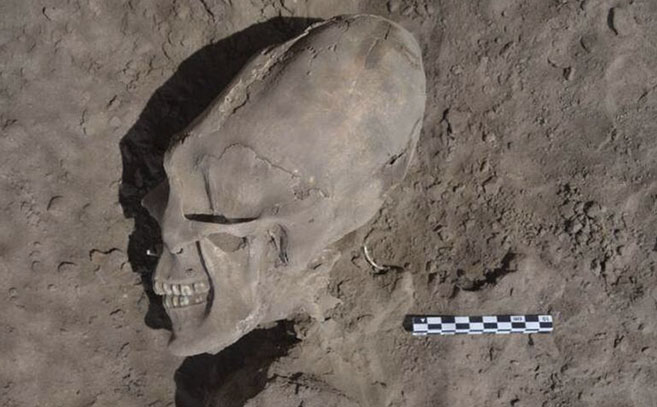
“Between 5 and 10% of the skulls do not display the flat surfaces typical of intentional deformation, but instead exhibit a “natural” morphology.”
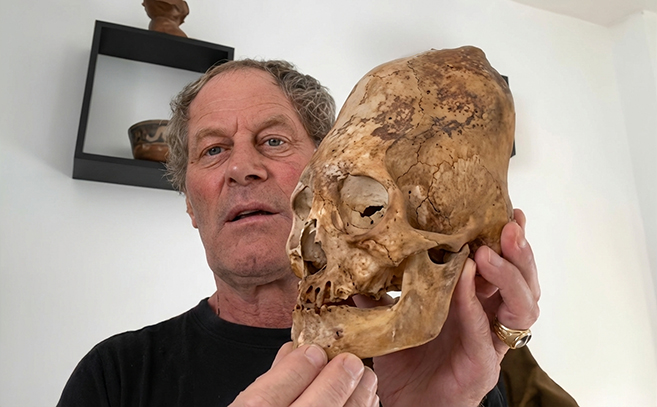
What makes the Paracas skulls so special? Unlike other well-documented examples of artificial cranial deformation — a cultural practice widespread across different periods and regions of the world — some of these skulls display characteristics that are difficult to explain solely by bandages or splints applied during childhood.
Foerster claims that between 5% and 10% of the specimens do not show the flat surfaces typical of intentional deformation, but rather a “natural” morphology, with a larger cranial volume and a weight above the human average. Physicians consulted by the researcher reportedly assured him that deformation can alter shape, but not increase cranial capacity, which is genetically determined.
The most controversial point arises with the DNA. Preliminary analyses reportedly detected genetic segments that do not correspond to any sequence recorded in GenBank, the largest genetic database in the world. They do not match modern humans, Neanderthals, or any other known hominins. However — and here it is worth turning down the volume of the ominous music — “not matching” does not automatically mean “not human.”
Ancient DNA is often fragmented, degraded, and exposed to contamination, and the lack of matches may be due to rare mutations, unsampled lineages, or simply technical limitations. One example is the controversial case of the three-fingered Nazca mummies, whose proponents claim their DNA is not human for the same reasons.
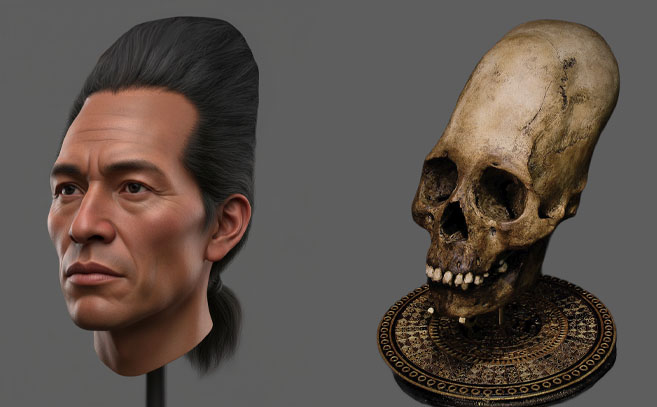
This nuance appears in Foerster’s discourse, as he insists that this is a first phase, almost a “scientific provocation,” and that only the repetition of the analysis on other skulls will reveal whether we are dealing with an isolated anomaly or with something more profound. In this sense, the fact that there are hundreds of Paracas skulls — rather than a single specimen, as is the case with other famous examples — favors serious research: replicability is possible.
The historical context also adds layers of mystery. The Paracas culture flourished more than 2,000 years ago and disappeared abruptly, coinciding with the expansion of the Nazca. Some remains attributed to Paracas elites show reddish or light brown hair and exceptionally tall stature for the coastal South American populations of the time, characteristics that have fueled hypotheses of migration from other regions of the world.
Infobae, in its coverage of the topic, addresses these peculiarities from a more institutional and cautious perspective, relying on Peruvian archaeological sources and emphasizing that, to this day, the most widely accepted explanation remains cultural rather than biological.
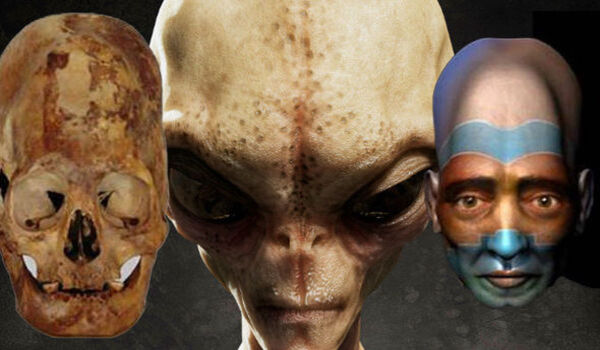
And what about the inevitable extraterrestrial question? Foerster does not shy away from it, but he also does not dive headfirst into flying-saucer theories. He speaks of interbreeding, of possible ancient transoceanic migrations, and leaves the door ajar — very much ajar — for more extreme scenarios.
Studies have identified evidence of elongated skulls dating back two or three thousand years, coinciding with the Paracas period, in the Black Sea region and Crimea, which would suggest a migratory pattern. From a journalistic standpoint, this ambiguity is honest: it acknowledges the unknown without asserting it as certainty. Something that, in matters like these, is almost revolutionary.
In addition, the skulls under study reveal that the blood type does not correspond to the results found in Mexico and throughout South America. In this region, the most common blood type is O, in 100% of cases, but within the Paracas culture, 28.5% are type A; 7.1% are type B; 21.4% are types A and B, considered the rarest blood type on the planet; and 43% are type O. Why do these differences exist?
For now, the conclusion is as frustrating as it is fascinating. There is no proof that the Paracas skulls belong to “non-humans,” but there is also no comprehensive genetic study — published and replicated — that definitively closes the case. What we are dealing with is an ongoing investigation, independently funded, that requires transparency, external review, and, above all, time.
In mystery, as in science, quick answers are usually the least reliable. And Paracas, once again, reminds us that the past still holds secrets… although not all of them have almond-shaped eyes or come from the stars.