



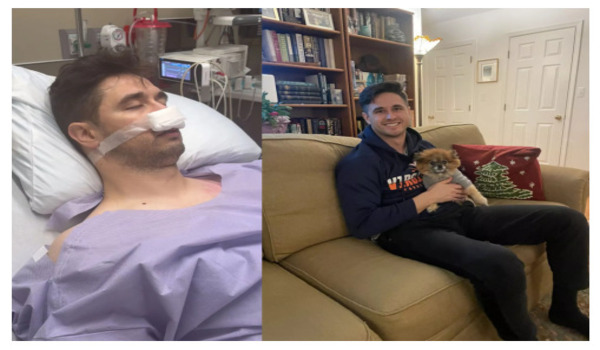
Imagine undergoing a routine knee surgery and, upon opening your eyes, uttering sentences in a language you believed you did not know. That is exactly what happened to Stephen Chase, a 30-year-old American whose story began to cause astonishment far beyond the hospital corridors and reignited debates about the human mind, memory, and for some, the paranormal.
Chase entered the operating room as a native English speaker, with such a basic knowledge of Spanish that, according to him, he could barely count to ten or pronounce a few words after sporadic classes in high school. However, upon waking from anesthesia after a knee surgery during his adolescence, he found himself speaking Spanish fluently for about twenty minutes, before inexplicably returning to his usual English.
The extraordinary nature of the case does not end there: this pattern repeated itself in three different surgeries over more than a decade. On each occasion, upon awakening from anesthesia, this “other linguistic self” emerged, spoke Spanish with surprising fluency, and shortly afterward disappeared, leaving no trace in Chase’s conscious memory.
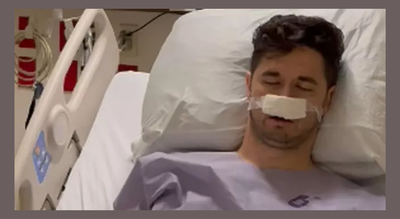
The doctors who evaluated Chase believe that his experience corresponds to what is clinically known as Foreign Language Syndrome. It is an extremely rare disorder, documented in only about a dozen cases in the medical literature and described in recent studies, such as those published in the Journal of Medical Case Reports, in which patients under anesthesia temporarily begin to use a second language after surgery.
The scientific explanation suggests that general anesthesia or the surgical stress itself may temporarily alter the way the brain accesses linguistic memory networks. In this sense, the phenomenon could be due to a temporary reorganization of certain brain areas after anesthesia, activating latent circuits for languages to which the individual was exposed at some point, even if they were not consciously learned, as suggested by Chase’s own history, having grown up hearing Spanish in his environment.
From a neurological point of view, this syndrome remains a mystery: there is no clear consensus on why it occurs, what the predisposing factors are, or how it might be prevented. Some documented cases suggest that the native language may be temporarily “blocked” while a second language is being overloaded, something that could be related to the way anesthetics such as propofol or midazolam interfere with memory and access to stored memories.
Other equally impressive cases have been reported around the world
Other equally impressive cases have been reported around the world, showing that the episode experienced by Stephen Chase is not unique. Over the years, different medical and journalistic reports have documented similar situations in which patients began speaking another language after neurological trauma, surgery, or periods of unconsciousness.
One of the most well-known international cases is that of Ben McMahon, an Australian who suffered a serious car accident in 2013 and remained in a coma for more than a week. Upon waking, to the surprise of his family and medical staff, he began speaking fluent Mandarin, despite having had only basic contact with the language before the accident. His English gradually returned, but the episode drew worldwide attention for demonstrating how the brain can access latent linguistic memories after brain trauma.
Another widely reported case occurred in 2016 and involved the American teenager Reuben Nsemoh, who suffered a severe concussion during an American football game. After several days in a coma, when he regained consciousness, he began communicating exclusively in Spanish, even though he had only limited exposure to the language before the incident. Over time, his ability to speak English was gradually restored, while the Spanish almost completely disappeared.
A third example took place in 2025 in the Netherlands, when a 17-year-old boy underwent a routine knee surgery. Upon waking from anesthesia, he showed an abrupt change in language, experiencing difficulty with his native language and temporarily speaking only English, a language he had learned solely at school. Doctors classified the condition as a rare manifestation of what is known as Foreign Language Syndrome.
These episodes, although extremely rare, reinforce the idea that the human brain may store linguistic information in a much deeper and more complex way than previously assumed. In extreme situations such as trauma, general anesthesia, or coma, these circuits can be activated unexpectedly, revealing abilities that had remained hidden.
Despite scientific attempts to explain the phenomenon, many of these cases still challenge the full understanding of modern neurology, remaining on the boundary between medicine, psychology, and the great mysteries of the human mind.

Xenoglossia or natural explanations?
The story of Stephen Chase has sparked the imagination of researchers who study unusual linguistic phenomena, prompting renewed interest in more spectacular, almost paranormal accounts associated with the concept of xenoglossia. The term, coined by French physiologist Charles Richet in the early twentieth century, refers to the alleged ability of a person to speak or write in a language entirely unknown to them, often attributed in historical reports to trance states, hypnotic regression, or even demonic possession.
Classic stories include individuals who, during spiritualist sessions or under hypnosis, reportedly began to “master” ancient languages such as Latin or Aramaic without ever having learned them, as well as accounts of multiple personalities that shifted languages depending on their state of consciousness. However, most of these cases have been heavily criticized due to the lack of objective evidence and the presence of more plausible alternative explanations, such as cryptomnesia, which involves the unconscious recall of fragments of a language previously heard but never fully learned.
Xenoglossia, when interpreted as a paranormal phenomenon, lacks solid scientific support. The most widely accepted evidence suggests that what appears to be an unexpected command of a language may, in many cases, result from the temporary activation of previously stored linguistic memories or from transient reorganizations of neural function caused by trauma, anesthesia, or dissociative states.
In medicine, what is better documented are temporary alterations in spoken language following brain injury or anesthesia, including foreign accent syndrome and variants of Foreign Language Syndrome. Although extremely rare, these conditions have far more plausible neurological explanations than hypotheses involving possession or paranormal manifestations.
A case that will continue to spark debate
For Stephen Chase, what happened appears to be more of a biological phenomenon than a spiritual mystery. His story sheds light on the complexity of the human brain, an organ capable of storing and activating linguistic memories in ways that science is only beginning to understand. At the same time, it invites reflection on how we interpret the unexplained, ranging from the most conservative medical explanations to the frontiers of the paranormal.
Either way, from Utah to the farthest reaches of parapsychology, Chase’s story reminds us that the human brain remains a territory as fascinating as it is enigmatic.