



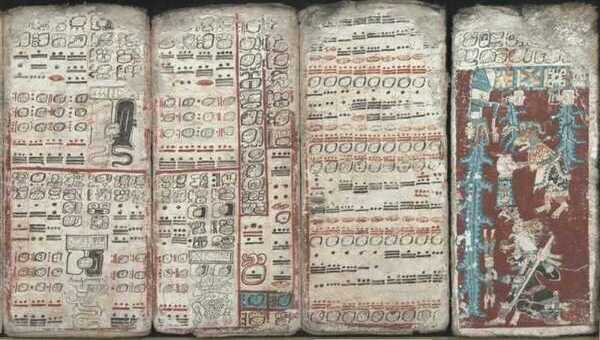
A new study published in Science Advances offers the most complete explanation to date of how the eclipse table in the Dresden Codex—one of the few surviving Maya books—actually worked. The research, conducted by John Justeson and Justin Lowry, shows how Maya astronomers developed a highly sophisticated system for predicting solar eclipses, correcting misinterpretations that persisted for more than a century.
For centuries, scholars recognized in the codex’s complex sequence of numbers and glyphs a mechanism for eclipse prediction, but the way it functioned remained a mystery. The new analysis reveals that the Maya system was based on a profound understanding of lunar cycles and maintained its accuracy for more than 700 years.
Correcting a historical error
Until now, scholars believed that when creating a new table, the Maya began calculations from the final date of the previous one. Justeson and Lowry demonstrate that this procedure would have caused cumulative errors, leading to increasingly unreliable predictions. Instead, the Maya “keepers of time” adopted a more complex and stable strategy.

The eclipse table in the Dresden Codex spans 405 lunar months — a value chosen not at random, but as part of a relationship with the sacred 260-day calendar, used in ritual and divinatory practices. The researchers propose that Maya astronomers initially created a general table of 405 months to link the Moon’s cycles to this sacred calendar. This combination produced an almost perfect alignment between the two systems, which led to the creation of the eclipse table as a specialized version of this lunar calendar.
Structure and functioning of the table
The table does not include all 405 months, but rather 69 specific new-moon dates, called “stations.” Of these, 55 were designated as moments when solar eclipses could be visible in the Maya region, while 14 served only to maintain the structural coherence of the system. The stations are separated by regular intervals of 5, 6, 11, or 17 months, which preserved the table’s connection to the 260-day calendar.

The most remarkable point of the study is the discovery of the method the Maya used to “restart” the table and maintain its accuracy over the centuries. Instead of beginning a new cycle at month 405 of the previous table, they did so at one of two strategic points: month 358 or month 223.
These months showed the smallest deviation from the exact alignment of the Sun, Moon, and Earth — about 2 hours and 20 minutes in the first case, and 10 hours and 10 minutes in the second. Normally, the new cycle would begin at month 358; occasionally, to correct accumulated drift, it would start at month 223.
The authors calculated that the ideal proportion would be four restarts at month 358 for every one at month 223, resulting in a cycle of 1,655 months — equivalent to roughly 134 years and with an average error of less than 51 minutes, an exceptional level of precision for an ancient civilization.
A legacy of continuous observation
The analysis also suggests that the system has origins far earlier than the codex itself. A precursor model may have emerged around A.D. 550, based on centuries of astronomical observations. The table in the Dresden Codex is thought to have been composed between A.D. 1083 and 1116, likely because it begins and ends with eclipses visible in the Yucatán Peninsula — rare events that may have motivated its preservation.
The study thus reveals a dynamic and cumulative scientific tradition. Maya astronomers were not only sky-watchers, but also mathematicians and model builders who refined predictions based on empirical data and long temporal sequences.
As the authors conclude, the evidence demonstrates a continuous development of lunar theory among Maya specialists beginning around A.D. 350. This rediscovery corrects a long-standing historical distortion and offers a new perspective on the intellectual sophistication of Maya astronomers, whose observational rigor allowed them to create one of the most precise predictive systems of the ancient world.