


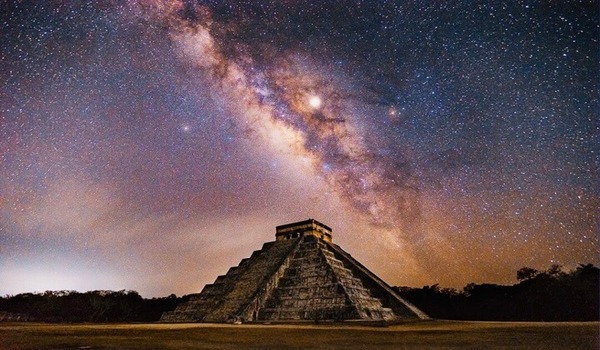
Scientists from Mexico and the United States are finalizing the details of an unprecedented archaeological mission at the Chichén Itzá archaeological site. The goal is to explore the interior of El Castillo (also known as the Temple of Kukulcán) using muons.
But what exactly is a muon? For the general public, it can be imagined as a kind of subatomic “super-particle” produced when cosmic rays from outer space collide with Earth’s atmosphere.
These particles pass through almost everything they encounter, including solid rock, but they lose energy or are deflected depending on the density of the material they traverse.
By placing special detectors at the base of the pyramid or within its tunnels, scientists can measure how many muons pass through it.
If they detect an excess of particles in a specific area, it indicates the presence of a void or chamber; if fewer are detected, the material is solid. Essentially, it is like taking an X-ray of a 30-meter-tall structure using the universe’s natural energy.

This technology is not new, but its application in archaeology has produced surprising results in recent years.
The most famous example is the Great Pyramid of Giza in Egypt, where the ScanPyramids project used this same technique to discover the so-called “Great Void,” a 30-meter-long cavity that had remained hidden for millennia. Following this international success, Mexico has also become a pioneer in this field.
The team led by Dr. Arturo Menchaca Rocha has already carried out a similar experiment at the Pyramid of the Sun in Teotihuacan, establishing the foundations for the methodology that will now be applied to help decipher the mysteries of the Maya civilization.

However, transferring this technology to Chichén Itzá presents a much greater physical challenge than previous projects. Unlike the drier environments of other pyramids, scientists on the Yucatán Peninsula must install high-precision equipment under conditions of around 32 degrees Celsius and humidity close to 100%.
“We work in a way that is the reverse of traditional experimental physics, adapting ourselves to a confined space where the air is saturated with vapor,” said Dr. Edmundo García Solís, principal investigator at Chicago State University, describing the complexity of operating inside the pyramid.
This technological effort aims to complement what traditional archaeology has already revealed. It is known that El Castillo was built like an “onion,” with different architectural phases layered on top of one another; in fact, a Chac Mool sculpture and a red jaguar throne were found within its internal substructures in the 1930s.
Despite these discoveries, specialists suspect that the pyramid has not yet revealed all of its treasures.
The hypothesis put forward by experts such as archaeologist Virginia E. Miller suggests that an even older structure may exist at the base, potentially housing a royal tomb of great importance.
The scanning work will last six months and will be crucial for the preservation of the archaeological site.
Ultimately, the mapping will allow these theories to be confirmed or refuted without the need for invasive excavations, protecting the integrity of this World Heritage Site while modern science seeks answers in the past.