



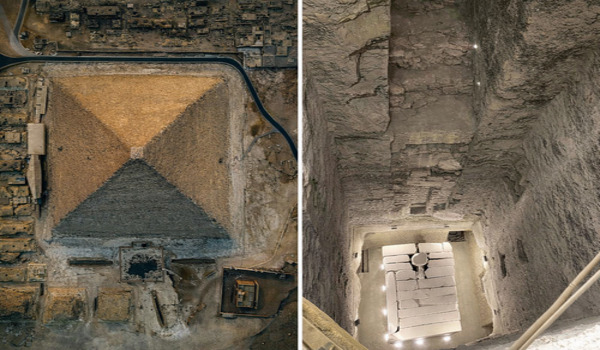
The construction of the Great Pyramid of Egypt has long remained one of archaeology’s greatest mysteries, particularly due to the absence of ancient records explaining how its massive stone blocks were transported and assembled in such a relatively short time.
Conventional explanations typically rely on the use of external ramps and a slow, layer-by-layer construction process. However, these theories struggle to explain how stones weighing up to 60 tons could have been raised to great heights within a period of roughly twenty years.
A recent study offers an alternative hypothesis, suggesting that the pyramid was built using an internal system based on movable counterweights and pulley-like mechanisms embedded within the monument’s structure.
Published in the journal Nature, the research by Dr. Simon Andreas Scheuring of Weill Cornell Medicine in New York presents calculations indicating that builders could have positioned massive blocks at an astonishing pace, at times, as fast as one block per minute.
According to the study, such efficiency would only have been possible through the use of sliding counterweights, which could generate the necessary energy to lift stones to the upper levels of the Pyramid of Khufu, greatly reducing reliance on brute human force.
The analysis also highlights internal architectural features that support this model. The Grand Gallery and the Ascending Passage are interpreted as inclined ramps suitable for the movement of counterweights, functioning as part of the lifting system.
Meanwhile, the antechamber, long regarded as a security feature, is reinterpreted as a pulley-like mechanism capable of assisting in raising even the heaviest blocks.
If confirmed, the study suggests that the Great Pyramid was constructed from the inside out, beginning with an internal core and using hidden lifting systems to raise stones as the structure expanded.

The Great Pyramid of Khufu, the oldest and most imposing of the pyramids at Giza, was erected around 2560 BC as the tomb of Pharaoh Khufu, approximately 4,585 years ago.
Despite its funerary purpose, the pharaoh’s mummy and his presumed treasures were never found. Even so, the monument endured through the millennia as the tallest structure ever built by humans for much of history, and it remains the only one of the Seven Wonders of the Ancient World that is still largely intact.
The pyramid is renowned for the extraordinary precision of its engineering, composed of millions of stone blocks, as well as for a complex system of internal corridors that lead to the King’s Chamber.
According to the recent study, massive counterweights descended along inclined internal passages, generating the force necessary to lift stone blocks in other areas of the structure’s core.
In this interpretation, Scheuring proposes that the Ascending Passage and the Grand Gallery were not designed for ceremonial purposes, but instead functioned as internal ramps during the construction process.
The researcher highlights the presence of scratches, wear marks, and highly polished surfaces on the walls of the Grand Gallery as evidence that large sleds repeatedly slid along its length. These traces point to mechanical stress consistent with the movement of heavy loads, rather than simple human circulation or ritual use.
The study also presents a new interpretation of the Antechamber, a small granite compartment located immediately before the King’s Chamber.
Traditionally understood as a protective feature against tomb robbers, the Antechamber is reinterpreted as a type of lifting station, operating in a manner similar to a pulley system.

Deep grooves carved into the granite walls, stone supports that may once have held wooden beams, and an unusually rough finish all point to a functional machine rather than a fully finished ceremonial chamber.
In Scheuring’s reconstruction, ropes would have passed over wooden logs fixed within the antechamber, allowing workers to lift stone blocks weighing up to 60 tons.
The system could be adjusted to increase its lifting capacity when necessary, operating in a way similar to changing gears.
Large rope grooves and an uneven, encrusted floor suggest that the chamber was once connected to a vertical shaft, which was later sealed after construction was completed.
Beyond individual rooms, Scheuring argued that the entire internal layout of the pyramid reflects engineering constraints rather than a symbolic design.
The main chambers and passages cluster around a common vertical axis but are oddly offset rather than perfectly centered.
The Queen’s Chamber, for instance, is centered along the north–south axis but not along the east–west axis, while the King’s Chamber lies noticeably south of the pyramid’s central axis.
Such irregularities are difficult to explain if the pyramid was carefully planned from the base using external ramps.
Under a traditional model, builders would have been free to place the chambers wherever they wished, with perfect symmetry.
Instead, the offsets suggest that the builders were working around mechanical limitations imposed by internal lifting systems.
The theory also offers explanations for intriguing external features, including the slight concavity of the pyramid’s faces and the complex pattern in which the stone layers gradually change in height.
According to Scheuring, these features may reflect how internal ramps and lifting points shifted as the pyramid rose and the stones used at higher levels became lighter.
Crucially, the model makes testable predictions, suggesting that no large unknown chambers remain hidden within the pyramid’s core—an idea supported by recent muon-scanning surveys.
However, smaller corridors or remnants of internal ramps may still exist in the outer portions of the structure, particularly at higher levels.
If confirmed by future discoveries, Scheuring’s proposal could fundamentally reshape how archaeologists understand not only the Great Pyramid, but pyramid construction throughout ancient Egypt.