



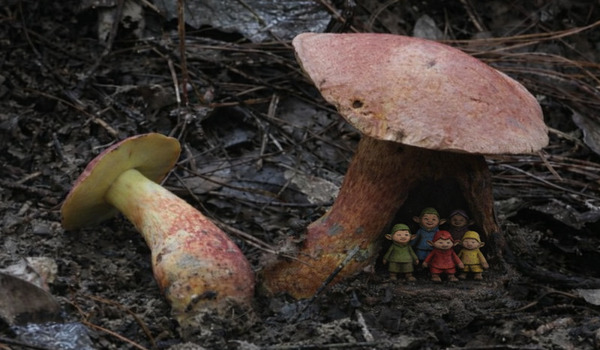
Every year, as mushroom season begins, medical staff at a hospital in China’s Yunnan province know what is coming: a significant increase in patients reporting highly unusual visual experiences. The accounts are strikingly similar. Tiny humanoid figures appear in rooms, slip under doors, climb walls, or move among furniture.
Although the descriptions sound like folklore or fantasy, the hospital treats hundreds of such cases annually. The cause is neither psychiatric illness nor the use of known recreational drugs, but a familiar ingredient in local cuisine: the mushroom Lanmaoa asiatica.
This species grows in a symbiotic relationship with pine trees in nearby forests and is widely consumed in Yunnan, where it is prized for its rich umami flavor. During the rainy months, from June to August, the mushroom is common in markets, restaurants, and home kitchens throughout the region.
Problems arise when it is not prepared properly. If eaten raw or undercooked, L. asiatica can trigger vivid hallucinations that are remarkably specific and consistent.
According to biologist Colin Domnauer, a researcher at the University of Utah and the Utah Museum of Natural History, this risk is well known among local residents. During a visit to a mushroom hotpot restaurant, he witnessed an unusual precaution. A timer was set to ensure sufficient cooking time, accompanied by a warning that eating before it rang could result in “seeing little people.”
For Domnauer, such practices demonstrate how deeply ingrained knowledge of the mushroom’s effects is within local culture. Yet outside Yunnan, and aside from a handful of scattered reports elsewhere, Lanmaoa asiatica remained a scientific mystery for decades.
For years, mycologists encountered stories of a mushroom capable of producing nearly identical visions in different people, but the species responsible had never been formally described. Mycologist Giuliana Furci, founder and executive director of the Fungi Foundation, notes that the topic was long surrounded by fragmented accounts and frustration among researchers who failed to locate the organism.
Today, Domnauer is working to unravel this long-standing mystery. His research aims to identify the unknown compound responsible for the mushroom’s unusual hallucinatory effects and to understand why the human brain responds in such a uniform way. He believes that studying L. asiatica may offer valuable insights not only into little-known fungi, but also into the mechanisms of perception and consciousness.
Domnauer first learned about L. asiatica as an undergraduate student through his mycology professor. The idea that people from different cultures and time periods could report nearly identical visions caused by a natural organism struck him as deeply strange and sparked a curiosity that has since grown into an international scientific investigation.

Academic literature had already offered some clues. In a paper published in 1991, two researchers from the Chinese Academy of Sciences described cases in China’s Yunnan province involving people who had eaten a certain mushroom and subsequently experienced what they called “lilliputian hallucinations.” In psychiatric terminology, the phrase refers to the perception of tiny human figures, animals, or fantastical beings. The name comes from the diminutive inhabitants of the fictional island of Lilliput in Gulliver’s Travels.
According to the researchers, patients reported seeing these figures “moving everywhere,” often with more than ten small beings present at once. They described seeing them on their clothes while getting dressed and on their plates while eating. The visions became even more vivid when their eyes were closed.
Similar accounts had surfaced decades earlier. In the 1960s, American writer Gordon Wasson and French botanist Roger Heim, who helped introduce Western audiences to psilocybin mushrooms, encountered comparable reports while working in Papua New Guinea. They were investigating a mushroom that missionaries who had visited the region about 30 years earlier claimed caused “madness” among local populations. An anthropologist later referred to the condition as “mushroom madness.”
Unbeknownst to them, what Wasson and Heim encountered closely resembled the reports that would later emerge from China. They collected specimens of the suspected species and sent them to Swiss chemist Albert Hofmann, the discoverer of LSD, for analysis. Hofmann, however, failed to identify any compound of interest. The team concluded that the stories they had heard were likely cultural narratives with no pharmacological basis, and no further research followed.
It was not until 2015 that researchers formally described and named Lanmaoa asiatica, still with little understanding of its psychoactive properties.
What became clear is that psilocybin is not responsible for the lilliputian effects associated with L. asiatica. Domnauer’s first goal, therefore, was to confirm the true identity of the species. In 2023, he traveled to Yunnan during the peak of the summer mushroom season. He visited the province’s large mushroom markets and asked vendors which mushrooms “made people see little men.” Laughing, the sellers pointed out certain specimens, which Domnauer purchased and later took back to the lab for genomic sequencing.
The results confirmed the identity of L. asiatica, he says. In a study currently being prepared for publication, chemical extracts from laboratory specimens produced behavioral changes in mice similar to those reported in humans. After receiving the mushroom extracts, the mice exhibited a phase of hyperactivity followed by a prolonged period of stupor, during which they barely moved.
Domnauer also traveled to the Philippines, where he had heard rumors of a mushroom causing symptoms similar to those described in historical records from China and Papua New Guinea. The specimens he collected there looked somewhat different from the Chinese ones. They were smaller and pale pink, compared with the larger, redder mushrooms found in Yunnan. Genetic testing, however, revealed that they were indeed the same species.
In December 2025, Domnauer’s advisor visited Papua New Guinea in search of the mushrooms mentioned in Wasson and Heim’s accounts. None were found, and their identity remains unknown.
“It could be the same species, which would be surprising, since Papua New Guinea does not typically share species with China and the Philippines,” Domnauer says. Alternatively, it could be a different species, which would be even more interesting from an evolutionary perspective. That would suggest that similar lilliputian effects evolved independently in different mushroom species in entirely separate parts of the world.
There is precedent for this in nature. Scientists, including some working in Domnauer’s own laboratory, have recently shown that psilocybin evolved independently in two distantly related groups of mushrooms.
Even so, Domnauer emphasizes that psilocybin is not the compound responsible for the unusual effects of Lanmaoa asiatica.

Domnauer and his team are still trying to identify the chemical compound responsible for the hallucinations caused by Lanmaoa asiatica. Current tests suggest that it is likely unrelated to any known psychedelic substance. One of the strongest clues lies in the unusually long duration of the experiences it produces.
The effects do not begin immediately. They typically start 12 to 24 hours after ingestion and can last from one to three days. In some cases, they have even led to hospitalizations lasting up to a week. Because of the extraordinary length of these experiences and the risk of prolonged side effects, such as delirium and dizziness, Domnauer says he has never personally tried the mushrooms raw.
These intense and extended episodes may help explain why people in China, the Philippines, and Papua New Guinea do not appear to have a tradition of deliberately seeking out L. asiatica for its psychoactive effects. According to Domnauer’s findings, the mushroom has always been consumed purely as food, with hallucinations occurring as an unexpected side effect rather than an intended outcome.
Another striking factor is the consistency of the visions themselves. Most known psychedelic compounds tend to produce highly individual experiences that vary not only from person to person, but also from one occasion to the next in the same individual. With L. asiatica, however, the pattern is remarkably stable. Reports of seeing small human-like figures appear again and again across different cultures and settings.
“The perception of little people is reported very consistently and repeatedly,” Domnauer says. “I don’t know of any other substance that produces hallucinations this consistent.”

Fully understanding this mushroom will not be an easy task, Domnauer says. Even so, as with research into other psychedelic compounds, the scientific work it inspires could ultimately address some of the most fundamental questions about consciousness and the relationship between the mind and reality.
The findings may also shed light on what causes spontaneous lilliputian hallucinations in people who have never consumed Lanmaoa asiatica. The condition is rare. As of 2021, only 226 non mushroom related cases had been reported since lilliputian hallucinations were first described in 1909.
For those affected, however, the outcome can be serious. About one third of patients who experienced cases unrelated to mushroom consumption did not fully recover.

Studying Lanmaoa asiatica may help scientists better understand the brain mechanisms behind naturally occurring lilliputian visions and could even lead to new treatments for people who develop this rare neurological condition, Domnauer says.
“We can now begin to understand where in the brain these lilliputian hallucinations originate,” says Dennis McKenna, an ethnopharmacologist and director of the McKenna Academy of Natural Philosophy, a nonprofit educational center in California. He agrees that understanding the compounds found in the mushroom could lead to the discovery of new medicines. “Whether there is any therapeutic application remains to be seen,” McKenna says.
Researchers estimate that fewer than 5 percent of the world’s fungal species have been described, highlighting what Furci calls the enormous potential for new discoveries in the planet’s increasingly threatened ecosystems. Furci, whose work focuses on exploring the fungal kingdom, notes that fungi possess a vast biochemical and pharmacological library that scientists are only beginning to explore. “There is still an entire world of discoveries waiting to be made,” she says.








Those mushrooms, or something very simiar are also found in the Black Hills in SD. I’ve found them there in grassy pastures in the Hills. They even have a blue bruising when handled which I considered could be indicative of a oxidation reaction like psylocibin but they were identical in appearance to the Boletus pictured.
Ireland would like a word