


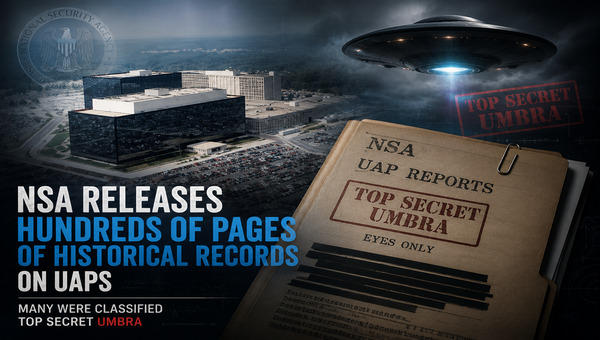
The documents were obtained through the Freedom of Information Act (FOIA) by the Disclosure Foundation, which has been conducting a broad legal campaign aimed at reviewing declassification procedures involving historical records connected to the UFO/UAP phenomenon.
According to the foundation, the initiative is part of a wider legal strategy designed to bring disclosure efforts closer to the courts and expand public access to documents that had long been kept under strict secrecy by U.S. intelligence agencies.
The origins of this newly released collection of records trace back to a historic case in 1980, when a Freedom of Information Act lawsuit was filed against the U.S. National Security Agency, the NSA. The lawsuit was brought on behalf of a group of citizens seeking to compel the agency to release any UFO-related records in its possession.
At the time, the NSA strongly resisted the lawsuit. As part of its defense, the agency’s then-director of policy, Eugene Yeates, submitted classified sworn declarations to the court known as “in camera” submissions. This legal procedure occurs when sensitive materials are reviewed privately by the presiding judge without public access to the contents.
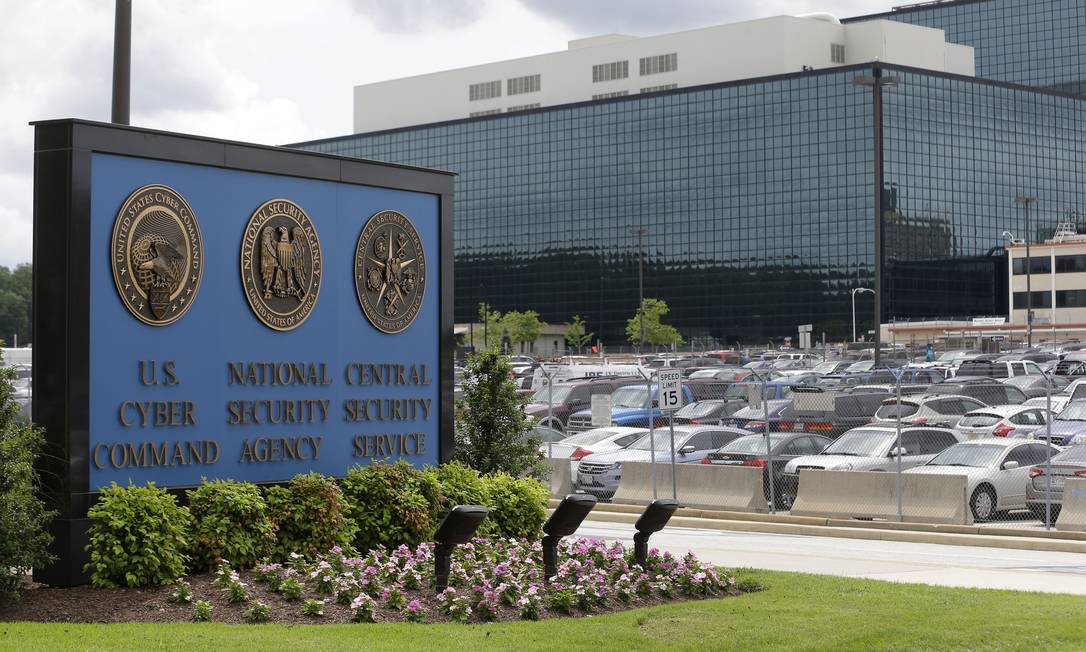
Although the so-called “Yeates Memorandum” was declassified in 2009 and later made publicly available, the underlying data and supporting materials used in its preparation remained hidden for decades.
The Disclosure Foundation’s legal team later requested access to the supporting documents used by the NSA in drafting the confidential memorandum. Initially, the agency denied the request in full. After a lengthy administrative battle and legal appeals, the NSA’s own appeals authority acknowledged that the blanket denial had been improper.
As a result, hundreds of pages of historical documents were ultimately released to the public. Many of these records carried the classification “TOP SECRET UMBRA,” one of the most sensitive secrecy categories associated with signals intelligence and electronic interception operations.
Despite what has been described as a historic disclosure, the NSA continues to maintain extensive redactions and withholdings in UAP-related materials dating back to the 1960s. According to the Disclosure Foundation, its legal team is still reviewing the agency’s justifications and intends to pursue additional appeals against what it considers improper withholdings.

What “TOP SECRET UMBRA” Means
A large portion of the records released by the NSA carry the designation “TOP SECRET UMBRA,” one of the most restrictive security classifications ever used within the United States intelligence community.
The term “TOP SECRET” represents the highest level of government secrecy. Under historical U.S. classification standards, information placed under this category is considered capable of causing “exceptionally grave damage” to national security if disclosed without authorization.
“UMBRA,” meanwhile, is a codename historically associated with extremely sensitive signals intelligence compartments. The U.S. National Archives’ Information Security Oversight Office specifically warns that designations such as “UMBRA,” “TALENT-KEYHOLE,” “RUFF,” or “GAMMA,” when combined with Secret or Top Secret classifications, indicate material considered highly damaging to national security if improperly disclosed, regardless of the age of the records.
This context is important because it helps illustrate the true significance of the disclosure. The central issue is not whether every document conclusively proves the existence of non-human technology or unknown craft. Rather, the most significant aspect is that the U.S. government treated certain UAP-related reports as information of extreme sensitivity for decades.
What the Documents Reveal
Although many pages remain heavily redacted, the visible portions contain repeated references to radar tracking of unidentified flying objects, visual sightings reported by multiple witnesses, objects traveling across large distances, and specific information regarding altitude, direction, and movement.
The records also include military assessments describing some incidents as “probably balloons,” along with references to foreign and military communication channels that remain substantially censored. Numerous pages additionally contain declassification markings tied to Executive Order 13526, as well as redacted passages citing Public Law 86-36 / 50 USC 3605, a statute commonly used to protect sensitive NSA operations, methods, and intelligence sources.
Another significant detail is the structure of the records themselves. These are not narrative reports or modern investigative summaries. They are formatted intelligence communications containing message identifiers, classification markings, redaction justifications, and operational-style reporting language typical of internal military and intelligence traffic from the period.
Cases Considered More Anomalous
Several of the more legible entries include the assessment “probably balloons.” However, an initial review of the full 334-page release reveals multiple incidents where no conventional explanation is provided and where the reported characteristics appear inconsistent with ordinary balloon activity.
Among the most notable cases is an entry found on page 314 describing two objects displaying yellow lights flying at low altitude. According to the report, the objects silently changed direction from north to west without producing any audible sound.
Another case, documented on page 330, describes an object performing rapid vertical movements, ascending and descending abruptly, while witnesses reportedly concluded it was “impossible for it to be a conventional aircraft.” The report also mentions an intense bluish-white light and erratic curved maneuvers.
On page 329, a document classified as “SECRET LARUM” describes an object with a spherical or disc-like shape, “brighter than the sun,” with an apparent diameter equivalent to half the visible size of the Moon. The report includes precise directional and azimuth data for the object above cloud cover.
Another report, found on page 333, describes an “elongated fireball moving at high speed” that later split into three separate luminous objects.
Page 322 references an object emitting a spiral-pattern luminous radiation approximately 22 meters in length while gaining altitude silently.
The records also document direct military responses to unidentified objects. At least eight reports mention fighter aircraft being scrambled to intercept UFOs. In one of the most dramatic incidents, 13 MIG fighter jets were reportedly deployed to pursue a single unidentified target.
Other records describe entire groups of objects detected simultaneously, including formations of 72 objects in one case and 23 in another, flying at altitudes exceeding 21,000 meters.
There are also reports involving multiple independent witnesses. One document classified as “SECRET SAVIN,” found on page 315, describes separate observers reporting the same silent lights changing direction at an estimated distance of roughly 600 meters. The technical structure of the report, including exact times, coordinates, and standardized operational descriptions, reinforces the intelligence-reporting nature of the material.
Click here to download the full document.