



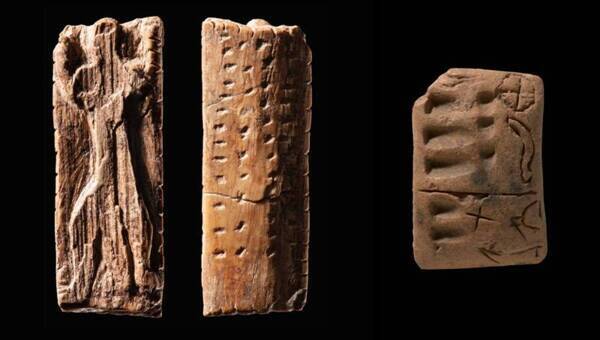
This conclusion was reached by a recent study led by linguist Christian Bentz and archaeologist Ewa Dutkiewicz, who demonstrated that the signs carved into Stone Age objects possess a surprisingly informative structure.
The research, published in the journal Proceedings of the National Academy of Sciences (PNAS), was based on the computational analysis of more than 3,000 geometric marks found in caves in Germany and other parts of Europe.
Key pieces include the iconic artifact known as “the Adorant”, a mammoth ivory plaque depicting a hybrid figure, and several sculptures from the Swabian Jura, where Paleolithic humans meticulously engraved patterns of dots, crosses, and notches that now take on new scientific significance.
Although we still cannot “read” exactly what these inscriptions mean, the team used computational linguistics tools and machine learning algorithms to measure their statistical structure.
“Our analysis shows that, although these signs do not represent spoken language like modern writing does, they are also not random decorations,” Professor Bentz explained.
It is a system of symbols designed to record thoughts and coordinate human groups, with statistical efficiency comparable to the earliest clay tablets from 5,000 years ago.

“Our analysis shows that, although these signs do not represent spoken language like modern writing does, they are also not random decorations,” Professor Bentz explained.
It is a system of symbols designed to record thoughts and coordinate human groups, with statistical efficiency comparable to the earliest clay tablets from 5,000 years ago.
The fingerprint of information
The most surprising aspect of the study is the similarity between these Paleolithic marks and Proto-Cuneiform from Mesopotamia. Although they are separated by 40,000 years, both share a common feature: the systematic repetition of signs.
This discovery suggests that the human capacity to encode information into symbols did not emerge suddenly with civilization, but was instead a long process of development that unfolded over thousands of years.
Hunter-gatherers already possessed the cognitive skills necessary to create portable “databases” that fit in the palm of the hand.

The study does not reveal what Stone Age humans were trying to record with these signs. “But the findings may help us narrow down the possible interpretations,” explained Dr. Ewa Dutkiewicz.
Although modern humans today have access to thousands of years of accumulated information and knowledge transfer that people at that time did not, anatomically speaking, Stone Age humans had already reached a stage of development similar to that of modern humans.
This means they likely possessed cognitive abilities comparable to our own. The ability to record and transmit information to others was extremely important for Paleolithic humans.It may have allowed them to coordinate groups or even helped them survive.
“They were highly skilled craftspeople. You can see that they carried the objects with them. Many of the objects fit in the palm of the hand. That is another way in which the objects are similar to proto-cuneiform tablets,” she concluded.