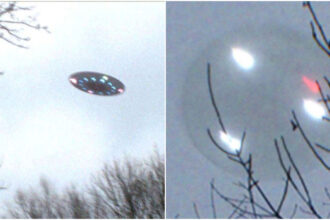




Ancient myths describing celestial visitations to Earth are being revisited by four academics from major American universities who chose to explore the subject from a scientific perspective.
In line with the title referencing “ancient aliens,” the essay argues that longstanding narratives about celestial beings may deserve renewed consideration in light of contemporary discussions about non-human intelligences.
Among the authors is Tim Lomas, a psychology researcher at Harvard University, alongside Michael P. Masters of Montana Technological University; Steven Brown of Ohio State University; and Brannon Wheeler of the United States Naval Academy.
They contend that academia should be more open to examining the possibility that non-human intelligences may have interacted with humanity in ancient times.
The paper, titled “Celestial Belonging: A Defense of Scientific Interest in Humanity’s Longing for the Heavens and Its Possible Origins Therein,” was recently released as a preprint on ResearchGate.
In it, the authors suggest that certain ancient myths and religious traditions referring to angels and other celestial phenomena may have some grounding in reality, while emphasizing the need for careful and rigorous investigation.
According to the researchers, nearly all human cultures preserve narratives linking humanity’s origins to the stars.
They argue that the recurring presence of such accounts across civilizations may point to a phenomenon worthy of interdisciplinary study.
The essay also clarifies that the project was undertaken out of personal scholarly interest rather than as part of formal institutional research.
While popular portrayals such as the television series Ancient Aliens or the works of Erich von Däniken are often criticized for lacking scientific rigor, the authors maintain that a growing body of discussion and data regarding UAPs justifies more structured academic inquiry.
The paper compiles numerous references and presents itself as a broad theoretical survey of the topic.

The study gains relevance because, for decades, academia treated accounts of angels or extraterrestrial life as mere mythical constructions of ancient societies.
However, contemporary episodes involving phenomena and non-human intelligences are increasingly being analyzed with seriousness, including in hearings before the United States Congress.
At the same time, several sources regarded as credible maintain that such occurrences are not recent, but rather part of human experience since remote times.
One frequently cited example is Timothy Phillips, former acting director of AARO. In an interview last year, he stated that the phenomenon has accompanied humanity since its earliest beginnings and had already been described as something extraordinary in biblical texts.
Another figure mentioned is Christopher Mellon, who served as Deputy Assistant Secretary of Defense for Intelligence under Bill Clinton and George W. Bush. In a post on X, Mellon stated that there is a growing body of evidence indicating that at least one extraterrestrial civilization may have encountered Earth and could be monitoring or even influencing humanity’s development.
The authors of the essay also place themselves within a broader movement of academics who, outside their institutional agendas, dedicate themselves to the study of UAPs.
One of the coauthors serves as an associate researcher at The Visible College, an independent group formed by scholars interested in investigating the topic.
The text further adds that several strands of modern physics suggest that reality is far more complex and less intuitive than traditionally assumed.
From this theoretical perspective, non-human intelligences might not simply be visitors from other planets, but entities associated with a shared field composed of something like mind or information, possessing an ontological status that transcends or even bypasses the strictly physical realm.
“From this perspective, NHI may be understood less as visitors from other planets and more as participants in a shared field composed of something like mind or information, beings whose ontological status transcends or even avoids the physical,” the article states.