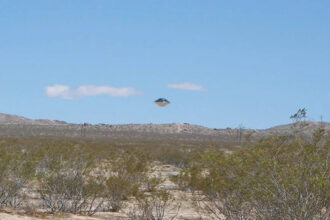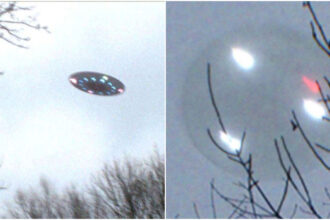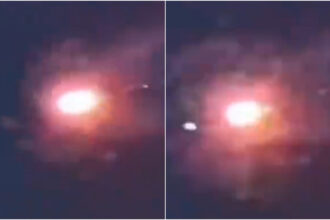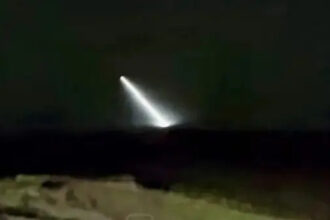



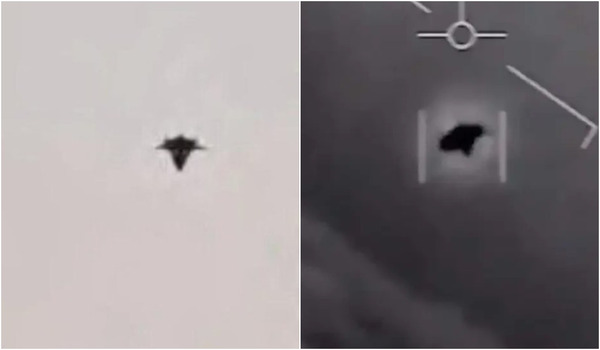
Chinese scientists have successfully revealed and tested a vertical takeoff and landing (VTOL) drone, whose shape, according to Chinese media, bears a striking resemblance to the object captured in the famous “UFO Gimbal” footage.
In 2015, a U.S. Navy F/A-18 pilot, flying off the East Coast aboard the USS Theodore Roosevelt, encountered something inexplicable: an unidentified flying object in a “spindle shape,” moving without any visible means of propulsion.
The footage, coded as “Gimbal” and officially declassified in 2021, sparked global speculation about unidentified aerial phenomena and raised serious questions about advanced aerospace technologies beyond known military capabilities.
Although still in the experimental stage, this new Chinese aircraft represents a radical shift in aerodynamic design, with the potential to enhance durability, stability, and multi-mission versatility in unmanned operations. Unlike most drones, its fuselage is centered around an elliptical ring-shaped wing that integrates a straight central wing section, forming a closed-loop structure.
Four rotors are mounted at the junctions between the elliptical wings and vertical stabilizers, serving both as lift generators and structural reinforcements. At first glance, the drone resembles more a flying spindle than a conventional fixed-wing aircraft or quadcopter.
According to the design team led by Professor Liu Zhanhe of Zhengzhou University of Aeronautics, the seemingly futuristic shape was carefully calculated to optimize performance and stability, reflecting significant advances in Chinese aeronautical engineering, reported the South China Morning Post.

The vertical fin extends both upward and downward, anchored to the ring-shaped wing and blending seamlessly into the fuselage. It not only houses avionics and payloads but also contributes to lateral stability during hovering flight.
Beneath the smooth external structure, a carefully designed airflow field comes into play. High-pressure zones under the lower front wing are channeled toward the front of the horizontal tail, creating a stable airflow that enhances control authority even at high angles of attack.
Meanwhile, the horizontal stabilizer, mounted at the wingtips instead of the fuselage, prevents turbulence along the inner wing, improving lift and control efficiency. The entire structure—integrated, continuous, and load-sharing—maximizes structural integrity while minimizing parasitic weight.
“It combines the best of both worlds, from multirotor aircraft to fixed-wing aircraft,” wrote Liu and colleagues in a peer-reviewed article published in the Chinese journal Experimental Technology and Management in June.
For decades, aircraft designers have faced a fundamental trade-off: vertical takeoff and landing capabilities offer unmatched operational flexibility, while fixed-wing flight provides the range and efficiency required for longer missions. Most VTOL drones sacrifice one for the other.
This new design appears to bridge that gap. During takeoff and landing, all four rotors provide stable and precise hovering—ideal for operations on ships, uneven terrain, or even water surfaces.
Once airborne, the vehicle transitions smoothly into horizontal flight. The hybrid elliptical wing generates substantial lift through a combination of circulation control and enhanced pressure differential.

Computer modeling suggests extraordinary flight performance: the lift curve slope of the elliptical wing is more than twice that of a conventional straight wing. This means it generates lift more efficiently across a wider range of angles, delaying stall and enabling stable flight at low speeds and high angles of attack—critical for certain military applications.
More than just an aerodynamic curiosity, this drone is designed for practical performance, according to the project team. Its robust structure allows it to carry a variety of modular payloads, including high-resolution sensors, thermal imagers, life-saving equipment, emergency supply pods, and atmospheric samplers.
It can launch from a mountain ridge, fly long distances on a single charge, sample water quality during an environmental crisis, and return safely, operating reliably in complex terrain, coastal zones, and maritime environments where traditional drones often struggle.
Beyond military applications such as battlefield surveillance, the drone “holds significant potential for other uses, such as continuous multipoint water quality monitoring over water surfaces, rapid material delivery over water, and emergency water rescue operations,” the team added.
Although some similar designs have been proposed in the past, most remained theoretical. Critics argued that the spindle-like shape could generate excessive drag and instability.
According to the South China Morning Post, Liu’s team conducted multiple test flights in various locations. After a smooth, controlled vertical ascent, the drone transitioned into forward flight—accelerating with surprising force, its wings generating considerable lift.
Post-flight analysis confirmed that the lift coefficient exceeded that of conventional wings. The 116.19% gain in lift curve slope was validated under real-world conditions. Even at high angles of attack, airflow remained attached, thanks to the ring wing’s ability to manage vortices and delay flow separation.
However, the drone does have limitations, mainly due to aerodynamic drag.
The researchers said they are working to refine the airframe’s streamlined profile—smoothing sharp edges and corners to reduce pressure drag, and fine-tuning the elliptical wing’s curvature and aspect ratio to maximize the lift-to-drag ratio.
Flight control algorithms would also need to be optimized to minimize unnecessary attitude adjustments that generate induced drag.
Chinese scientists have proposed other radical VTOL drone designs, including a more streamlined version that could be launched from almost any warship.