



Have you ever imagined if “alien” life were right “under our noses”? And when I say “under,” I mean literally beneath us: in the oceans. The underwater world of our planet is fascinating and reveals an environment so mysterious and unknown that it could be considered truly alien.
More and more, as we send monitoring equipment such as sensors and cameras into the depths of the abyss, we capture images of the vast, rich, and complex biodiversity that inhabits these places. This makes us reflect that, within the water, still on our own planet, there exists an alien world waiting to be explored.
Among marine creatures, the octopus always arouses great fascination when we talk about “alien beings of Earth.” It is truly remarkable and seems entirely foreign to our usual environment.
However, the creature that may offer us insights closest to something alien, in terms of intelligence and communication, may not be as visually striking as the octopus.
Whales, with their complex and acute intelligence, may be the first among all terrestrial animals to attempt conscious communication with us. This attempt at communication could help us better understand forms of non-human intelligence and guide the search for life beyond Earth.
Magnificently, for the first time in history, humpback whales have been documented attempting to communicate with humans through aquatic signals. Just like smokers who create rings of smoke, these whales were observed forming rings of water bubbles — a form of communication that gives us a fascinating glimpse of their cognitive complexity.

According to SETI, scientists from the Institute and the University of California, Davis, have, for the first time, recorded humpback whales creating large bubble rings during friendly interactions with humans — similar to how smokers blow smoke rings. This behavior, previously little studied, may represent play or even a form of conscious communication.
Although it was already known that humpback whales use bubbles to corral prey or during disputes in courtship, these new observations reveal a different behavior: they are actively forming bubble rings in the presence of humans. For the WhaleSETI team, this type of interaction represents an important step in understanding non-human intelligence and, potentially, guiding the search for intelligent life beyond Earth.
Dr. Laurance Doyle, from the SETI Institute and co-author of the study, explains: “One of the central assumptions in the search for extraterrestrial intelligence is that intelligent beings would be interested in making contact with humans. Observing the curious behavior of humpback whales independently supports this idea on our own planet.”
Fred Sharpe, co-author of the study and affiliated with UC Davis, adds that humpback whales live in complex societies, use bubble tools, and even assist other species threatened by predators. “Now we observe them blowing bubble rings in our direction, possibly attempting to interact playfully, gauge our responses, or even communicate,” he said.
Marine photographer and co-author Jodi Frediani, also from UC Davis, emphasizes that this curious behavior is common. “We have identified several humpbacks from different populations around the world that voluntarily approached boats and swimmers, blowing bubble rings during these encounters. It is remarkable to witness this combination of curiosity and intelligence in action.”
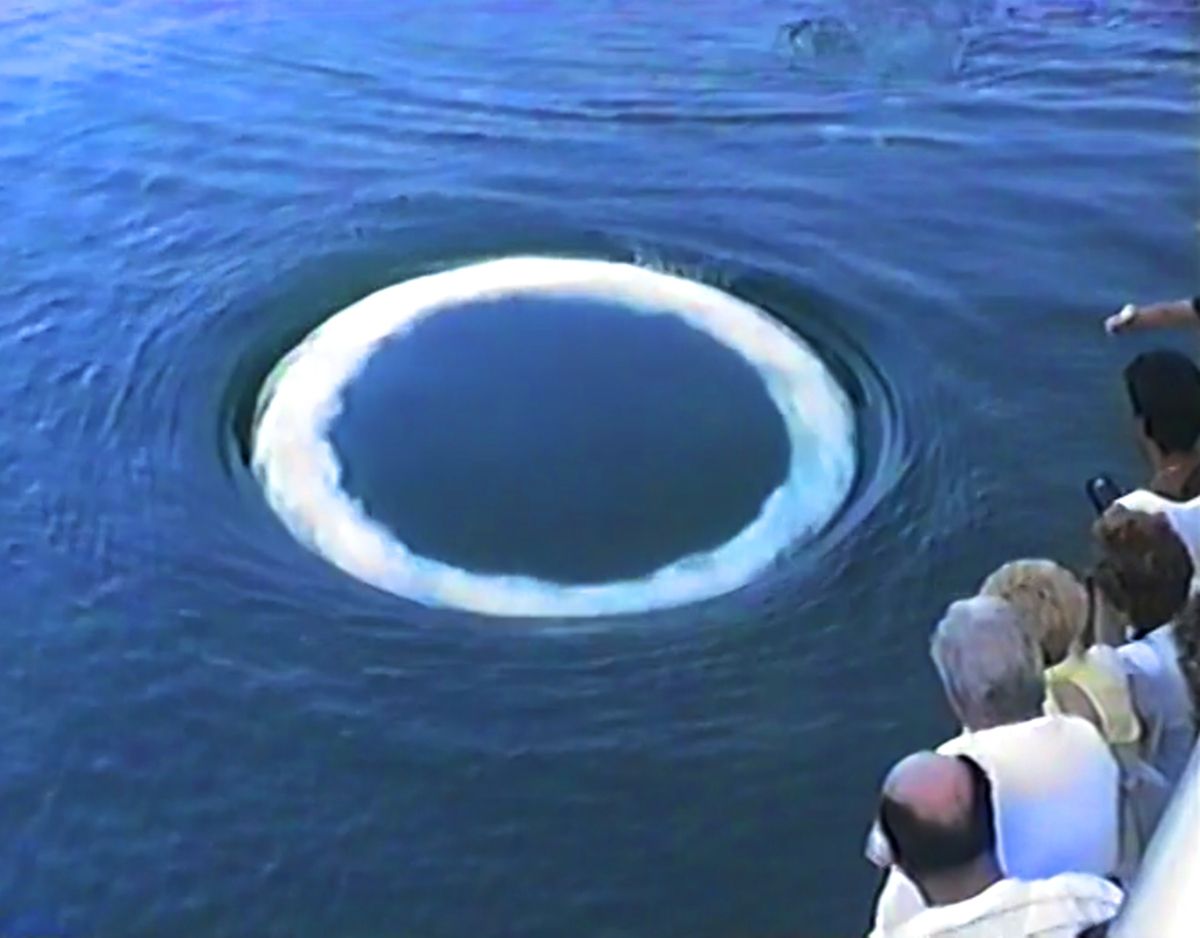
The team’s findings were recently published in Marine Mammal Science in an article titled “Humpback Whales Produce Bubble Rings in Poloidal Vortices.” The study analyzed 12 episodes of bubble-ring production, involving 39 rings created by 11 individual whales.
Similar to Antarctic studies or other terrestrial analogs used as proxies for Mars, the Whale-SETI team is investigating intelligent, non-terrestrial (aquatic) and non-human communication systems, aiming to develop filters that assist in the analysis of cosmic signals in the search for extraterrestrial life. As noted by Karen Pryor, “bubble-production patterns in cetaceans constitute a mode of communication not available to terrestrial mammals” (Pryor, 1990).
Other members of the team and co-authors of the article include Dr. Josephine Hubbard (postdoctoral researcher, UC Davis), Doug Perrine (photography), Simon Hilbourne (Marine Research Facility, Jeddah, Saudi Arabia), Dr. Joy Reidenberg (Icahn School of Medicine at Mount Sinai, NY), and Dr. Brenda McCowan (UC Davis, Veterinary Medicine), with expertise in animal intelligence, photography and humpback whale behavior, cetacean anatomy, and AI in animal communication analysis, respectively.
A previous article by the team was published in PeerJ, titled “Interactive Bioacoustic Playback as a Tool to Detect and Explore Non-Human Intelligence: ‘Conversing’ with a Humpback Whale from Alaska.” The authors would like to thank the Templeton Foundation’s Diverse Intelligences Program for their financial support of this work.
For more information, visit WhaleSETI.
Watch the video of one of them named Thorn, using the form of communication in the presence of humans.
Humpback Whale Bubble Rings
byu/ErrorlessGnome ingifs