



The first writing systems are generally attributed to the Sumerians around 3400 BCE, and archaeological evidence supports this idea. However, it is possible that writing existed thousands of years before the five-thousand-year-old cuneiform tablets.
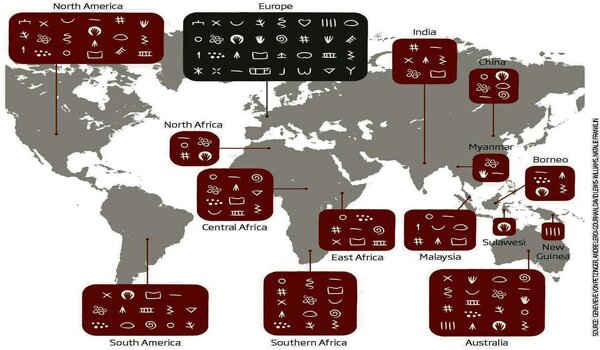
Paleoanthropologist Genevieve von Petzinger suggests that these prehistoric marks, including symbols resembling early hashtags, could have been almost as universal as modern emojis.
Symbols carved in caves around the world, such as peniforms shaped like feathers, claviforms shaped like keys, and hand stencils, show that humans were creating symbolic systems long before Sumerian writing.
According to Frank Jacobs of Big Think, these records may challenge the traditional narrative of human history as a period of darkness until the invention of writing.
Around 40,000 years ago, while painting animals deep in caves, early humans developed a set of symbols remarkably consistent across continents. Von Petzinger cataloged these signs in 52 caves across France, Spain, Italy, and Portugal.
She identified simple shapes like dots, lines, triangles, squares, and zigzags, as well as more complex forms such as ladder shapes, hand stencils, tectiforms resembling posts with roofs, and peniforms shaped like feathers.

Von Petzinger identified 32 distinct symbols spread across Europe, carved and painted over thousands of years. Jacobs emphasizes that “for tens of thousands of years, our ancestors seemed remarkably consistent in the symbols they used.”
According to von Petzinger, this system likely originated as humans migrated from Africa to Europe. In her book The First Signs: Unlocking the Mysteries of the World’s Oldest Symbols, she notes that these markings do not appear to be the result of a completely new invention, but rather a continuation of inherited knowledge.
In her TED talk, von Petzinger describes these abstract signs as an early form of communication, a precursor to today’s global networks of information. She points out that humans have long built upon the intellectual achievements of previous generations, often forgetting that these skills did not exist in the distant past.
The symbols themselves were not limited to cave walls; some were even engraved on deer teeth, forming necklaces.

Von Petzinger argues that the simplicity of these forms reflects a major cognitive shift, as early humans began using abstract symbols to convey meaning. However, not all scholars agree. The Bradshaw Foundation highlights Jean Clottes’ view that most European cave signs are closely tied to animal figures, suggesting they may not represent a step toward symbolic writing.
Other researchers, like MIT linguist Cora Lesure, propose a different interpretation. In a recent Frontiers in Psychology study, Lesure and her colleagues suggest that rock art represents early humans converting sounds into visual forms, a process analogous to the cognitive work behind language.
As Sarah Gibbens of National Geographic explains, these artworks may reflect the beginnings of symbolic thought.
In this view, cave art and accompanying symbols could be seen as a form of proto-writing, an early attempt to express ideas in a consistent and meaningful way. For tens of thousands of years, these symbols traveled with humans across continents, forming one of the first shared systems of visual communication.
What could this ancient mystery represent?

One possibility is that these symbols reflect a shared ancestral communication system. Before formal writing, our ancestors may have developed visual codes to convey ideas, record observations, or maintain communal rituals.
The consistency of these signs across different regions suggests they were not random, but part of a cultural repertoire that spread among human groups over thousands of years.
Another hypothesis is that these symbols represent a common proto-language, meaning that tens of thousands of years ago, humans may have spoken or understood, in some way, the same set of ideas represented graphically.
Even as spoken language diversified over time, these marks could have acted as a symbolic bridge capable of communicating universal concepts.
A third possibility is that these signs indicate cultural contact between distant groups. Despite the vastness of the continents and the challenges of travel, human communities may have met, exchanged experiences and knowledge, and carried these symbols with them.
In this case, they would be evidence of an ancient network of human interaction that we are only beginning to understand.
From a cognitive perspective, some researchers argue that these symbols represent a mental revolution.
he use of abstract forms for communication demonstrates the capacity for symbolic thought, which later enabled language, art, and writing systems. They not only record information but reveal how humans began interpreting and organizing the world conceptually.
Finally, a more exotic and mysterious hypothesis is that these symbols may have an origin or influence beyond what we know, perhaps connected to unusual collective experiences or even contact with unknown intelligences.
This view suggests that certain ideas or symbolic patterns were transmitted in ways that still escape conventional scientific explanation, making these proto-signs a true enigma of human origins.