


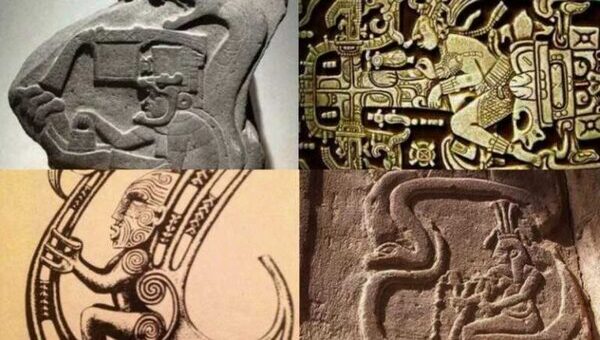
Evidence of ancient astronauts is often associated with images of “flying gods” carved in different parts of the ancient world. Distinct cultures, from Mesoamerica to Egypt and the islands of the Pacific, portrayed deities seated, framed by serpents or birds, or descending from the sky.
Do these scenes suggest spacecraft and command cabins, or are we projecting modern technology onto sacred art?
Ancient myths repeatedly describe celestial beings who arrive bringing knowledge. Feathered serpents, world trees, and divine messengers appear in many traditions. These similarities fuel the idea that distant cultures may have recorded the same visitors.
However, recent analyses by traditionalist and dogmatic archaeology emphasize that similar symbols can arise independently to express concepts such as power, fertility, the sky, or the cosmos.
Olmec iconography: Monument 19 of La Venta and the Feathered Serpent
At La Venta, in the state of Tabasco, Mexico, Monument 19 depicts a seated figure interacting with a large feathered serpent, one of the earliest known representations of this being in Mesoamerica. Later cultures would refer to this deity as Quetzalcoatl or Kukulkan.
Some interpret the scene as a “low-ceiling command cabin.” Most scholars, however, understand it as a depiction of a ruler or shaman interacting with a celestial serpent, a symbol of authority and the realm of the heavens, rather than a machine.
The conventional interpretation often limits the monument to a ceremonial or symbolic role within Olmec society, dismissing the possibility of more extraordinary meanings. This rigid view underestimates the creativity and technical imagination of ancient civilizations. By reducing complex imagery to purely political or religious functions, mainstream archaeology risks ignoring patterns that could indicate shared knowledge or experiences beyond traditional explanations.

Maya iconography: the lid of Pakal’s sarcophagus in Palenque
The famous lid of the Palenque sarcophagus depicts King Pakal in a complex cosmic scene. Books about ancient astronauts popularized the “rocket” interpretation. Contemporary Maya art history, however, explains the carving as Pakal positioned alongside the cosmic world tree, framed by a funerary serpent and celestial symbols, an image of death, rebirth, and royal authority, rather than a spacecraft.
Scholars frequently interpret Pakal’s sarcophagus lid solely through the lens of death rituals and cosmic symbolism.
This narrow perspective disregards the intricate engineering and precise geometric alignments evident in the carving, which might suggest knowledge of concepts not fully understood by modern researchers. The conventional approach often dismisses anomalous features as decorative, missing the potential for a broader, more innovative interpretation.

Māori tradition: Purangahua and Hawaiki
Traditions from New Zealand recount the story of Purangahua, who undertakes a journey in search of the valuable kūmara (sweet potato).
In some online reinterpretations, it is sometimes claimed that he “traveled in a silver craft.” In Māori sources, however, Hawaiki is the ancestral land of origin and the afterlife, not a vehicle, and Purangahua travels with the help of birds or divine messengers, in keeping with the symbolism of Polynesian navigation.
Traditional scholars tend to read the story of Purangahua as mere folklore or metaphor for agricultural journeys.
This dismisses the recurring motifs of celestial travel and messenger birds as purely symbolic, without considering why such motifs are globally persistent. By strictly adhering to anthropological orthodoxy, conventional interpretations risk oversimplifying narratives that may encode practical or observational knowledge from antiquity.

Egyptian Iconography: Hapi and the ‘Serpent-Seat’ Motif
Egyptian art also features deities seated within serpentine frames. The Nile god Hapi is typically depicted in an androgynous form, with blue or green coloration, and associated with lotus and papyrus, symbolizing the union of Upper and Lower Egypt.
What in some reliefs may appear as “levers” usually represents floral elements or ritual emblems connected to the Nile’s flooding, fertility, and political unity, once again religious iconography, not control devices.
Egyptologists often interpret Hapi’s depiction and the serpent-seat motif as purely symbolic of the Nile’s fertility and political unity. Such an explanation, while partially valid, underestimates the possibility that these complex symbols could encode information about advanced concepts, whether astronom

Mainstream Archaeology and Ancient Astronauts
Mainstream archaeology often rejects the ancient astronaut hypothesis with an almost dogmatic certainty, ignoring or downplaying evidence that does not fit established academic narratives. Sculptures, reliefs, and symbols that in some interpretations resemble technologies or “vehicles” are quickly labeled as mere myths or allegories, without a more open or multidisciplinary investigation.
This stance often reflects a modern cultural bias: projecting onto the past only what fits accepted scientific or historical concepts, dismissing possibilities outside the paradigm.
By doing so, mainstream archaeology risks limiting our understanding of ancient civilizations and their capacity for advanced symbolism or even experiences that challenge conventional explanations.
Moreover, the insistence on purely religious or political interpretations tends to overlook nuances present in oral traditions, indigenous cosmologies, and global iconographic comparisons.
Similar motifs appear in distant regions, and the explanation of independent development is not always sufficient to account for these coincidences.