



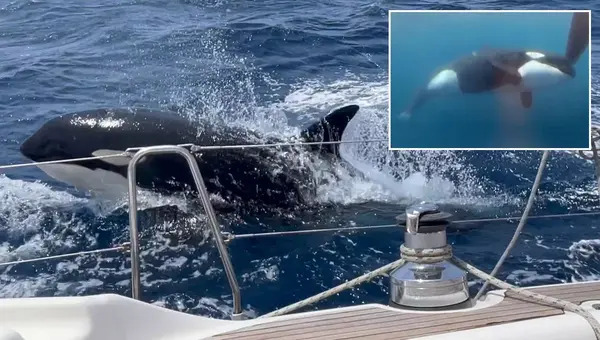
The group of orcas known as the Gladiators, which gained notoriety after a series of attacks on vessels in the Strait of Gibraltar, is believed to be communicating through a form of language previously unknown to science.
Since 2020, this group, led by a female known as White Gladis, has damaged rudders, struck yachts, and left sailors adrift along one of the world’s busiest maritime routes.
Researchers now believe they may have identified one of the factors behind the group’s efficiency and coordination, an exclusive communication system.
Orcas are known for their high intelligence, strong social organization, and complex communication, using a wide range of sounds to interact and coordinate hunting strategies.
To untrained human ears, these clicks, whistles, and grinding sounds often seem similar. However, studies funded by the Loro Parque Foundation have shown that different orca groups employ their own dialects, or “accents,” passed down from generation to generation, primarily from mother to calf.
In the case of the Gladiator group, however, researchers say this goes beyond a simple regional variation. Their vocalizations are radically different from any pattern previously recorded.
According to scientists, these orcas may have developed a singular, unique language, further reinforcing the unusual and intriguing nature of the group.
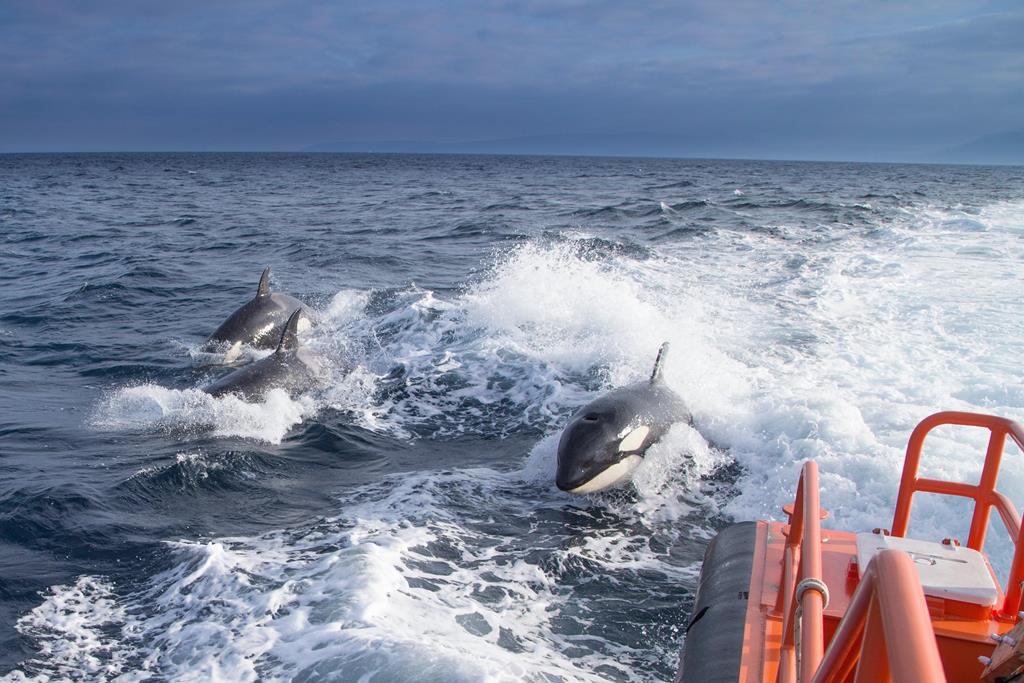
One of the most curious traits of the Gladiator group, whose name references the scientific designation attributed to the so-called gladiator orca (Orca gladiator), is its seemingly unusually silent behavior.
Orca groups are generally highly vocal, especially during hunting activities or social interactions. However, White Gladis and the other members of the group dismantled stranded vessels in what observers described as an unsettling silence.
According to scientists, this behavior does not indicate a lack of communication, but rather a deliberate strategy.
Like other groups, the orcas inhabiting the region around the Iberian Peninsula and the Strait of Gibraltar specialize in hunting a specific type of prey.
Because they are highly adapted to targeting tuna, a fish known for its constant alertness and quick reactions, these orcas have developed silent hunting techniques, avoiding any sound that could warn their prey.
In a recent study, researchers used state-of-the-art underwater acoustic equipment to capture low-intensity communications.
Within just a few hours of recordings, four distinct types of vocalizations were identified that do not correspond to any previously documented orca vocal patterns.
The study’s co-author, Dr. Renaud de Stephanis, president of the organization Conservation, Information and Research on Cetaceans (CIRCE) in Spain, told The Times that the group has been under observation for three decades.

Until recently, these orcas were believed to be almost silent. New analyses, however, have revealed that their calls not only exist but are entirely unlike any others previously documented. From the perspective of cultural conservation, the discovery is remarkable, comparable to suddenly uncovering an unknown human language in the heart of Europe.
The sounds identified are not merely different on the surface. They display profound structural variations when compared with the vocalizations of orca populations in the North Atlantic and the Pacific.
According to Dr. Renaud de Stephanis, the contrast can be likened to the difference between languages such as Arabic and Latin.
Researchers argue that these communication patterns are not innate, but learned over time.
Calves appear to acquire vocabulary and structural elements primarily from the dominant female and other group members as they mature.
These communicative abilities are crucial for passing down the group’s unique hunting strategies, allowing them to thrive in regions where certain prey species are plentiful.
The newly cataloged sounds were detected within a group of approximately 40 orcas, whose range extends from the Strait of Gibraltar along the Atlantic coast of the Iberian Peninsula, occasionally reaching the English Channel.
Of this total, around 15 individuals belong to the infamous Gladiator group, which has been linked to nearly 700 close encounters with boats and the sinking of several vessels.

Despite the incidents, scientists do not believe that White Gladis and the other members of the group are deliberately attempting to harm humans. Nor is there any evidence that orcas view humans as prey.
Instead, researchers suggest that the boat attacks may be part of an unusual form of play.
It is well documented that orcas sometimes adopt behavioral “fads,” developing habits or activities that offer no clear survival advantage.
The most famous example occurred in the Pacific Northwest, where a group of orcas began balancing dead fish on their heads as if they were hats.
The behavior quickly spread from one group to another, and before long many orcas in the region were observed wearing fish “hats.”
According to Dr. Renaud de Stephanis and other researchers, interacting aggressively with boats may be another such behavioral trend, one that could fade as suddenly as it emerged.
After tearing rudders from vessels, White Gladis and her group were seen striking the fragments for several minutes before apparently losing interest and swimming away.
This behavior suggests that the orcas may perceive boats as sources of novel stimulation or “toys,” without regard for the consequences of damaging a yacht.

Dr. Renaud de Stephanis had previously told the Daily Mail that this behavior should be understood as “playful rather than aggressive.”
According to him and other researchers, what has been documented in the Strait of Gibraltar, the Gulf of Cádiz, and along the coast of Portugal reflects a form of play-like behavior developed by a small subpopulation of orcas.
Researchers explain that the animals focus their attention on the rudders of sailing vessels because these components respond dynamically to contact.
When pushed, the rudder moves, vibrates, and provides resistance, features that appear to capture the orcas’ interest.
In short, the interaction is highly stimulating for them.