



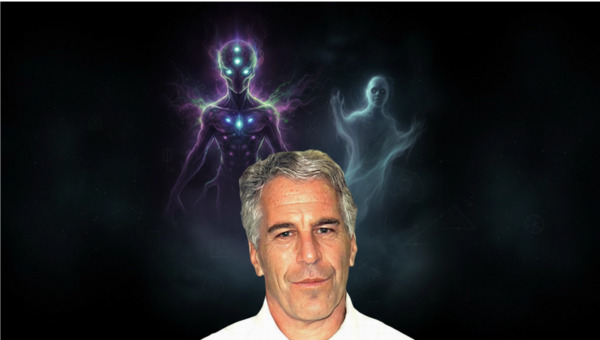
In the labyrinth of files emerging from the massive declassification of Jeffrey Epstein’s documents, more than six million pages detailing the extent of his network of contacts, emails, and movements, there is something that challenges the traditional logic of the case: a conversation with theoretical physicist Lawrence Krauss, from February 2018, in which the magnate appears to suggest that the rebuttal should be “focused point by point… dismantling the claims until they become ridiculous,” including, according to the text, references to topics that could verge on the paranormal and the extraordinary.
The files, part of the vast collection of documents released under the Epstein Files Transparency Act, show that Krauss, known for his defense of scientific thinking and his critical approach to dogma, responded to Epstein dealing almost exclusively with the administrative aspects of an article, rather than participating in a global crusade against the unexplained.
The leaked details point to a conversation about how to structure a response to a journalist, not to a coordinated strategy to discredit phenomena such as out-of-body experiences, abductions, or UFOs.

In light of the documents now available, it can no longer be claimed that there is no public evidence that Jeffrey Epstein explicitly asked a scientist to debunk certain phenomena considered paranormal.
An email dated February 26, 2018 (image above), sent from Epstein’s personal account to Lawrence Krauss, shows the financier asking him to write an article aimed at refuting claims about alien abductions, out-of-body experiences, and ghosts.
In the message, Epstein not only lists the phenomena he wanted challenged but also suggests arguments, such as the repetition of similar reports over a decade, and adds a particularly revealing element: the text should not include Krauss’s signature, pointing to a deliberate intention to influence public debate without exposing himself directly.
This exchange of messages, confirmed in the Epstein Files and accessible in document HOUSE_OVERSIGHT_031676, places Epstein’s interest in intervening in the narrative about the unexplained beyond speculation and into the realm of documented facts.
Alex Klokus is in the Epstein files
Alex Klokus is the lead investor in the UFO Disclosure Group Skywatcher that launched last year
Skywatcher purported that psionic assets would use psychic abilities to summon UFOs, they also said left handed, gays, and children were more… pic.twitter.com/APuHHpGcKN
— Red Panda Koala (@RedPandaKoala) February 2, 2026Another name that appears in the Epstein Files is Alex Klokus, one of the main investors in the UFO disclosure group Skywatcher.ai. The company allegedly claimed that its psionic agents would use psychic abilities to summon UFOs.
According to a tweet from the Panda Koala Network, “they consider left-handed people, homosexuals, and children more psychic than the rest of us.”
The organization Skywatcher.ai presents itself as a private initiative focused on aerospace intelligence and the analysis of unidentified aerial phenomena using advanced sensors, but there is something not mentioned on its website: the alleged psychic component.

Far from being a marginal or merely speculative idea, the hypothesis of using psychic abilities to interact with UAP phenomena (Unidentified Aerial Phenomena) appears to be linked to specific figures within the Skywatcher.ai community.
One of them is Jacob G. Barber, an active associate of the organization, who traveled to Washington in October 2024 to meet with members of the United States Congress.
According to available information, Barber reportedly testified about the existence of an alleged secret UFO retrieval program that would include the participation of individuals with psychic abilities, capable of influencing or interacting with UAPs.
This idea does not emerge out of nowhere; it connects with well-documented historical precedents, such as remote viewing and extrasensory perception programs funded by the Pentágono during the Guerra Fria, whose existence was later acknowledged.
In this context, Skywatcher’s claims about psychic resources cannot be dismissed simply as eccentricity but may be interpreted as part of a controversial institutional tradition that was never completely dismantled, only moved out of public view.

The question, therefore, is no longer whether Jeffrey Epstein moved among respected scientists and advocates of ideas considered marginal, because the documents confirm that he did.
The uncomfortable question is: why? Was he trying to discredit the paranormal as an exercise in controlling public discourse while others, in classified environments, were exploring those same capabilities? Or are we facing a deeper strategy in which ridiculing certain phenomena served to conceal sensitive research, programs inherited from the Cold War, or experiments that were never meant to come to light?
When the files show a financier requesting anonymous debunking efforts, investors linked to extreme UFO projects, and witnesses testifying before Congress about mediums involved in unidentified paranormal phenomena, the doubt stops being absurd and becomes inevitable: who decides what is fantasy… and what must be kept away from the public eye under the label of impossible?