



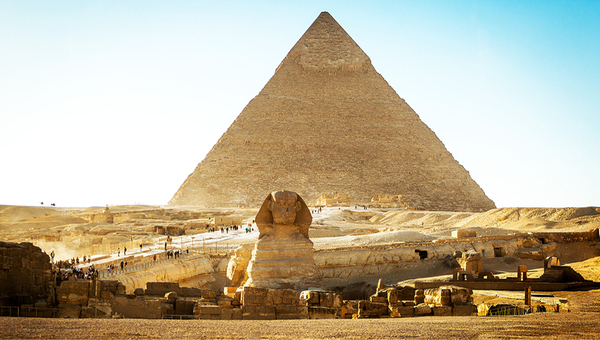
In a brief, non-peer-reviewed article, Ambrosio dates the construction of the Giza pyramids complex to around 12,000 years ago, long before the emergence of Egypt’s dynastic culture in 3100 BCE.
In this sense, he argues that the pharaohs simply “found” and reused these architectural marvels.
“The Giza pyramids were not built by the pharaohs of the Fourth Dynasty but were instead appropriated by them,” the author states in his article.
According to his view, pyramids built later were failed attempts to imitate a lost technology that the Egyptians could no longer master.
The mystery of an impossible engineering feat
The study highlights that no mummy or royal treasure has been found in the three main pyramids, despite their attribution to Khufu, Khafre, and Menkaure.
According to Ambrosio, the discovery of an empty sarcophagus in the Great Pyramid only proves that Khufu claimed the monument, not that he built it.
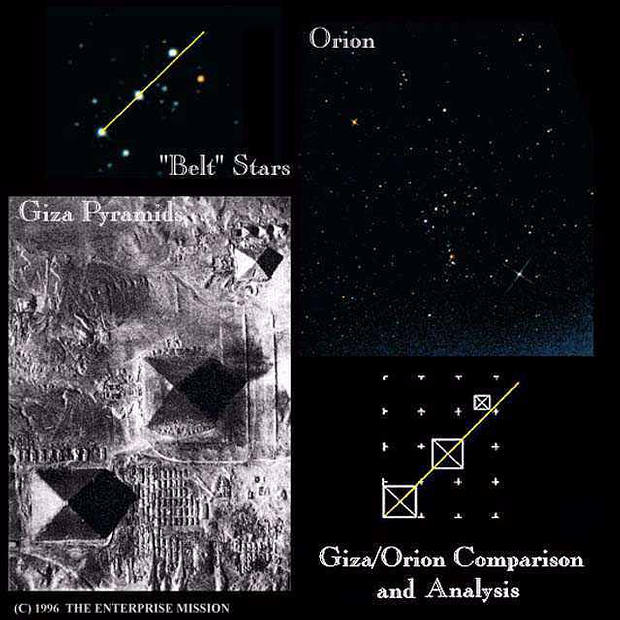
This theory aligns with arguments by well-known authors such as Robert Bauval and Graham Hancock, who suggest that the pyramids’ alignment with Orion’s Belt reflects astronomical knowledge more advanced than what is conventionally attributed to the late Neolithic period.
On the other hand, Ambrosio’s research reinforces the ideas of Spanish Egyptologist Manuel José Delgado regarding technological “devolution.”
While Giza displays millimeter-precise granite cuts and an almost perfectly leveled base, later pyramids show inferior materials and structural flaws.
Is there evidence beneath the sand?
Another key point is the water erosion detected on the Great Sphinx of Giza. Some geologists argue that this damage was caused by torrential rains that have not occurred in Egypt for millennia, placing the archaeological site in a much wetter and far more ancient era.

The study links these findings to the myth of “Zep Tepi,” or the First Time, a golden age in which, according to Egyptian texts, the gods ruled the Earth directly.
Recent reports from satellite scans using synthetic aperture radar (SAR), conducted by international teams, suggest the possible existence of a network of tunnels and chambers deep beneath the Giza Plateau.
These findings could be the final piece confirming that the legacy of a lost civilization remains hidden beneath the desert.