


Many researchers suggest that a highly advanced civilization once existed in Earth’s past but was wiped out due to mysterious circumstances. This argument is supported by archaeological discoveries that challenge contemporary scientific explanations.
One theory proposes that extraterrestrial beings visited the planet and shared knowledge and technologies, possibly resulting in astonishing advancements thousands of years ago that eventually led to humanity’s crisis. Some people claim that the ancients possessed technologies beyond our current understanding. Some modern innovations may perhaps have ancestral roots, an idea that remains little known.
Ancient narratives even mention the possibility of ancient nuclear wars and advanced aerial vehicles. It is suggested that ancient peoples possessed superior spacefaring abilities and cosmic understanding compared to modern civilizations.
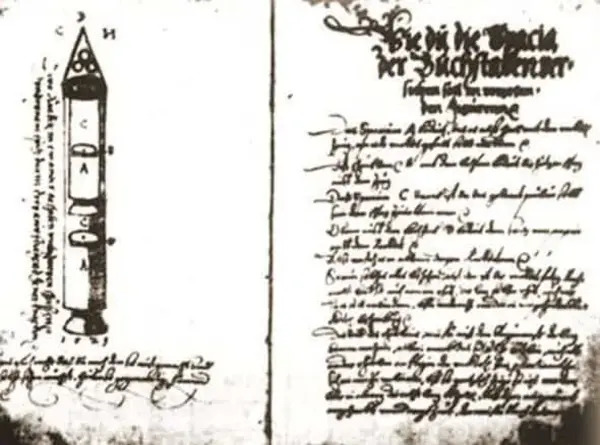
In 1963, Romanian engineer Doru Todericiu closely analyzed a 450-page manuscript in the national archives of Sibiu (formerly Hermannstadt). After carefully examining the manuscript’s scientific and technological content, he identified it as a work dealing with various complexities of artillery and ballistics, confirming its already known nature. Todericiu discovered that Conrad Haas, the author of the manuscript’s third section, had recorded remarkable concepts related to rocket construction.

The Sibiu Manuscript continues to intrigue researchers due to its discrepancy with the conventional historical narrative, attracting growing interest. Limited information is available regarding the life of Conrad Haas, who was born near Vienna, in Dornbach. Haas served the imperial court of Vienna as an artillery guard and commissioned officer. His path likely led him to Transylvania in 1551, when he joined the imperial forces, playing a crucial role as head of the artillery field at the Hermannstadt arsenal.
Between 1529 and 1569, Haas wrote the manuscript, which reveals, among other things, the earliest explanation of the fundamental principle behind multi-stage rockets. Haas discusses the assembly of rockets, stabilization through fins, and the application of liquid fuels, also describing and illustrating two-stage and three-stage rockets.
Written in German, the Sibiu Manuscript raises the assumption that it may have been formulated from even older texts. In detail, it outlines the principles underlying rocket manufacturing and presents sketches of three-stage space rocket models. Within the document, a repertoire of technologies combining pyrotechnics with weaponry is revealed, even encompassing the conception of a hang glider, while also instructing on the formulation of combustible mixtures intended to serve as liquid propellants for rockets.
Additionally, there are references to journeys to the Moon present in the text. According to Romanian scholars, the manuscript incorporates narratives of an individual who allegedly reached Earth’s satellite through a singular flying craft. Furthermore, the manuscript offers descriptions of an ancient fuel composed of several rare elements. These types of rockets were later launched from Cape Kennedy and employed by astronauts in the Mercury, Gemini, and Apollo programs.

It seems as though the author had a vision of the future. The Sibiu Manuscript comprises 450 pages, which contributes to its considerable length. The manuscript’s authenticity is undisputed among specialists, who nevertheless prefer to refrain from commenting on its content hastily.
One might dismiss this as science fiction were it not for the discovery of other peculiar texts and technologies by researchers of the past. Furthermore, numerous artifacts unearthed by archaeologists attest that our predecessors possessed a level of civilization far more advanced than modern historians once assumed. Manuscripts such as the Sibiu Manuscript hold the potential to revolutionize the way people conceive our history.
It remains a mystery whether Haas succeeded in implementing his projects and transforming them into reality. However, there are reports pointing to an event that allegedly occurred in Sibiu in 1550, where a rocket is said to have been launched. It is believed that Conrad Haas may have been the pioneer behind the creation of such a device. According to Haas, he devoted more than 25 years to the development of a singular flying craft. The greatest challenge in this context was finding a fuel capable of lifting it into the skies.
The primary focus of this article rests on the subject of propellants. Beyond conventional ingredients such as saltpeter powder, sulfur, and charcoal, Haas also incorporated “brandy” as an element, seeking to intensify the effectiveness of rocket propulsion:
“Once again, mix a little crushed gunpowder with a sufficient amount of brandy to form a paste. Then take it and apply it onto the small chamber (= rocket chamber), together with the tiny opening (= ignition hole) of the rocket.”
Haas also conducted experiments and employed other “fuel mixtures,” and it is noteworthy that the missile’s intended purpose dictated the specific combination to be used.
In summary, the following innovations and advancements may be attributed to Conrad Haas:
– The concept of multi-stage and clustered rockets
– The arrangement of propellant combinations in rocket stages
– The use of various fuel mixtures according to the type, performance, application, and design of rockets
– The integration of liquid-fuel propulsion
– The use of delta-shaped stabilizing fins
– The anticipation of the concept of modern spacecraft
Although Conrad Haas conceived military devices, he secretly upheld a belief in fundamental humanitarian values. His humanist essence becomes especially evident in this statement:
“However, my appeal is for peace, not for war. Let the weapons remain beneath the roofs, so that the bullet may not fly, and the gunpowder may not be wasted by moisture. Thus, the prince shall preserve his fortune, the man his weapons, and both shall preserve their lives. This is the counsel of Conrad Haas.”

The rocket’s technical characteristics are similar to those of modern vehicles. It was made of wooden parts covered by a layer of special stone powder, which was intended to protect the body from burning when rubbing against the air. Contemporary observers note that in the 16th century researchers did not understand the complexities of physical processes in the atmosphere, which is why some believe scientists may have received information from extraterrestrials.
Furthermore, from his youth, Conrad Haas devoted himself to researching ancient writings found in the territory of modern-day Egypt. A mission to the Moon may have occurred in 1550. However, there is no documentary evidence supporting all of these claims.
Lady Sala Shabazz, the founder of the Museum of Black Inventions, who passed away on March 28, 2002, once said:
“…Unfortunately, the individuals responsible for writing textbooks have often displayed prejudice and omitted other historical information. In an effort to cover vast periods of time, they summarized history and left out many other important facts, and this is something many people are unaware of.”
The city of Sibiu is known to many of us because it is the birthplace of Hermann Oberth, regarded as one of the three fathers of modern rocketry and astronautics. Additionally, there is a dedicated NASA document (ID 19770026087) in the archives concerning the Sibiu Manuscript.