




For decades, scientists assumed that consciousness — the subjective experience of being aware — was the pinnacle achievement of the human brain. Other animals, such as birds, which lack a cerebral cortex, were thought to act mainly on instinct rather than any form of introspection.
However, two new studies published in Philosophical Transactions of the Royal Society B challenge this long-held belief. Researchers from Ruhr University Bochum argue that consciousness is far older than previously assumed and much more widespread across the animal kingdom.
According to the authors, consciousness likely evolved as a practical tool for survival. And despite having brain architectures very different from those of mammals, birds display measurable signs of sensory awareness and even hints of basic self-recognition.
“Consciousness is not the ultimate triumph of human evolution,” the researchers write. “Instead, it appears to be a more fundamental cognitive process, potentially shared with many other animal phyla.”
A new framework for the mystery of consciousness

One of the enduring puzzles in modern neuroscience is not only how consciousness arises, but why it evolved in the first place. If natural selection favors traits that improve survival, what advantage does subjective experience actually provide? And why did humans and a handful of other species develop this ability while others — like oak trees — did not?
These are the central questions explored by philosophers Dr. Albert Newen and Carlos Montemayor in a study presenting a refined version of the ALARM theory of consciousness.
They argue that consciousness did not emerge fully formed. Instead, it developed gradually over evolutionary time through three functional stages — basic arousal, general alertness, and reflective consciousness — each tied to specific survival challenges.
The authors note that many modern theories overlook this evolutionary perspective. “The evolution of consciousness is a neglected topic that plays a surprisingly minor role in major contemporary theories,” they write.
Models such as Global Neuronal Workspace Theory (GNWT) and Integrated Information Theory (IIT) aim to explain how consciousness functions in the brain, but rarely address why it evolved.
At its earliest stage, basic arousal acts as an internal emergency alarm. According to the researchers, this mechanism “alerts the body and ensures survival,” stepping in when slower homeostatic processes are insufficient. Sensations like pain, fear, hunger, and other primary emotions belong to this level, helping an organism not only react to threats but recognize and avoid them in the future.
The second stage, general alertness, allows organisms to focus attention on specific environmental features — food, danger, heat sources, movement — and learn increasingly detailed patterns. This stage involves selective, goal-directed attention, enabling individuals to focus on what truly matters for survival and adaptation.
Finally, in some species — including humans, magpies, dolphins, and possibly other birds — reflective consciousness emerges, providing the ability to think about one’s own experiences and mental states. This level supports long-term planning, self-awareness, and sophisticated social behavior.
“Reflective consciousness involves metacognition about oneself or another agent, especially regarding mental states, emotions, desires, and beliefs,” Newen and Montemayor argue.
From this perspective, consciousness is not a mysterious phenomenon but a practical evolutionary tool — one that supports survival, learning, and social integration.
Birds as a case study in evolution’s ability to reuse ideas
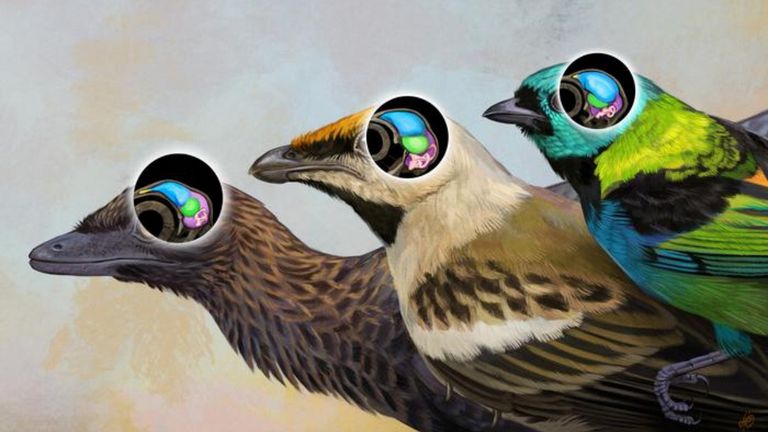
If consciousness is tied to survival and learning, evolution should be capable of producing it through multiple anatomical pathways — not only through the mammalian cortex. This is the premise behind a complementary study by cognitive neuroscientists Dr. Gianmarco Maldarelli and Dr. Onur Güntürkün.
The researchers turned to birds — whose evolutionary lineage split from that of mammals more than 300 million years ago — to test whether consciousness truly requires a mammal-like layered cortex. By examining their perceptual abilities and social behaviors, the team sought to determine whether avian species show genuine signs of sensory awareness or even basic self-recognition.
Their findings point in a clear direction. As the authors note, “There is growing evidence that (i) birds possess sensory consciousness and self-awareness, and (ii) they also have the neural architecture that may be necessary for it.”
Unlike humans, birds do not have a stratified neocortex. Instead, they rely on a structure known as the caudolateral nidopallium (NCL), a highly connected brain region that appears to perform functions similar to those of the mammalian prefrontal cortex. Recent experiments have shown that the NCL displays neural activity closely tied to subjective perception.
In their analysis, the researchers highlight two landmark experiments involving crows that together provide some of the strongest evidence yet for subjective experience in birds.
In both studies, the crows performed a delayed stimulus detection task in which very weak or near-threshold visual cues were presented in some trials and omitted in others. When the signals were ambiguous, the birds reported “seeing” them only about half the time — exactly the pattern expected when probing subjective perception.
What makes these experiments so significant is what happened in the brain. In both cases, neural activity in the caudolateral nidopallium (NCL) tracked the crows’ subjective reports rather than the physical stimulus itself. When a crow claimed to perceive a stimulus, NCL neurons fired even when nothing had been shown. And when the crow reported “not seeing,” those neurons stayed silent, even when a stimulus was physically present.
These findings suggest that sensory consciousness — the felt experience of seeing — is present in birds, arising through an evolutionary pathway entirely distinct from that of mammals.
Signs of Consciousness in Feathers
If sensory consciousness exists in birds, what about self-awareness?
Traditional mirror self-recognition tests have long been considered the gold standard for detecting self-awareness in animals. Only a few species pass it with ease: chimpanzees, dolphins, elephants, and — more controversially — magpies. Many bird species fail the test, but not due to a lack of cognitive ability. Instead, researchers argue that the mirror test simply may not fit their ecological context.
More ecologically relevant experiments are revealing something new. Chickens, for example, do not peck at a mark on their bodies, but they appear able to distinguish their reflection from another bird during predator-threat tests.
“Pigeons and chickens do not treat their reflection as they would a typical member of their own species… they show strong indications that they know their mirror image is not another conspecific,” the researchers write.
In other words, birds may indeed possess self-awareness, but it may manifest differently — and it may require the right context to be expressed.
Consciousness Without a Cortex?
Perhaps the most surprising implication of both studies is the notion that consciousness does not require a layered cortex. If birds possess subjective sensory experience, task-relevant awareness, and forms of ecologically dependent self-recognition, then consciousness may be far more flexible — and far older — than previously assumed.
Both studies suggest that the roots of consciousness run deeper in vertebrate evolution than neuroscientists once believed.
If this is true, the debate is no longer about whether birds are conscious, but rather which forms of consciousness evolution is capable of producing using radically different neural designs.
Their findings support the evolutionary framework of the ALARM theory, which holds that consciousness did not evolve all at once. Instead, it emerged in layers — alarm, attention, and self-reflection — each serving its own survival function.
Ultimately, the fact that birds display primitive versions of these layers suggests that consciousness may not be a fragile exception of human evolution, but one of nature’s most enduring innovations.
“Consciousness should not be viewed as an all-or-nothing cognitive function, but as a gradual and multidimensional process,” write Dr. Maldarelli and Dr. Güntürkün. “The results presented here contribute to the growing body of evidence that consciousness may be present across much of the animal kingdom, in species that are phylogenetically distant and possess remarkably different brain architectures.”







This research on distributed consciousness across species is fascinating from a biohacking perspective – if awareness exists on a spectrum rather than being binary, that changes how we think about optimizing our own cognitive performance. I’ve been experimenting with Quantress lately, which uses quantum frequency alignment tailored to your archetype, and it’s genuinely shifted how I approach focus and mental clarity compared to generic binaural tools. Makes you wonder if we’re underestimating consciousness in other organisms the same way we’ve been underestimating the role of frequency-based states in human performance.