


One of the greatest mysteries of the ancient world involving Easter Island may finally have been solved. Scientists claim to have identified who built the iconic stone statues over 900 years ago and, importantly, how they were transported.
In the past, researchers assumed that the statues, weighing between 12 and 80 tons, would have required the combined effort of hundreds of workers to carve and move them.
However, new archaeological evidence suggests that the Moai were not created by a single, powerful kingdom, as previously believed.
Instead, each Moai was carved by a small clan or family, with only four to six people working on each statue.
Using a new 3D model of the island’s main Moai quarry, archaeologists identified 30 unique “workshops” where the statues were produced.
Each clan appeared to have its own artistic style, specialized techniques, and preferred excavation sites.
Lead author Professor Carl Lipo from Binghamton University stated:
“We can clearly observe distinct workshops, each aligned with different clans working intensively in their specific areas. It is easy to see that one series of statues is being made here, another there, side by side.”

The production of Moai on Rapa Nui, Easter Island, began around the 13th century, when Polynesian communities started carving increasingly larger monuments.
By the time the first Western explorers arrived in the 1700s, nearly 1,000 statues were scattered across the island, with many more partially completed in the Rano Raraku quarry.
However, how and why this island community invested such vast resources into building these monuments remains a mystery.
“The quarry is like an archaeological Disneyland,” says Professor Carl Lipo.
“It has always been a treasure trove of information and cultural heritage, yet it is remarkably underdocumented.”
In a new study published in PLoS One, Professor Lipo and his colleagues attempted to solve this enigma by creating a detailed digital map of the quarry.
Using a drone, researchers captured around 22,000 photos of the site and combined them into a single 3D model that anyone can explore.
In addition to preserving the archaeological site for future research, this incredible map also revealed surprising details that had remained hidden in previous studies.

Professor Lipo states, “You can see things that would be impossible to observe from the ground. You can view the top, the sides, and any areas that are inaccessible on foot.”
More importantly, this revealed just how different each of the workshops actually was.
For example, Moai were typically carved by refining facial details first before outlining the head and body.
Others worked on the entire block before starting the face, while some sculpted laterally along the cliffs.
Similarly, some Moai display signs of a unique artistic vision, including statues with a distinctly feminine appearance.
The workshops also appear to have been organized according to natural features of the rock, rather than large geographic divisions.
Researchers say this suggests that access to the quarry was not controlled by a single authority, but that individual groups negotiated among themselves.
These findings challenge the view that large monuments like the Moai are evidence of a centralized, powerful hierarchy mobilizing many people for a single project.

This supports a growing body of evidence that building and transporting the Moai may not have required as much labor as previously thought.
It was once believed that the Moai were dragged from the quarry to their final locations, a process that would have required enormous effort.
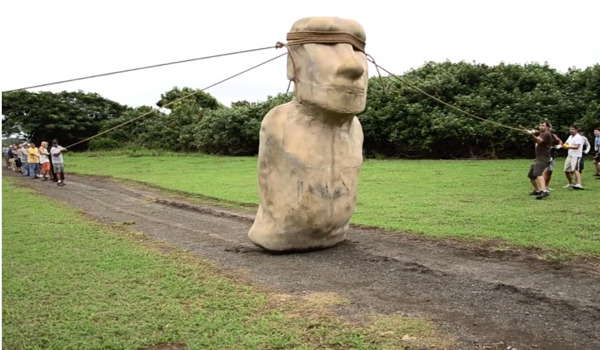
However, in a recent study published in The Journal of Archaeological Science, Dr. Carl Lipo and Dr. Terry Hunt found that the people of Rapa Nui likely used ropes to rock the statues in a zigzag pattern.
By attaching ropes to both sides of the head and pulling back and forth, the Moai could be rocked side to side and moved forward in a “walking” motion.

This technique would have allowed small teams to move the massive Moai over long distances with relatively little effort.
The stone heads were then transported along specially constructed “Moai roads” connecting the quarry to their final destinations.
About 4.5 meters wide and concave in profile, studies show that the specific shape of these roads helped stabilize the statues and increased the likelihood of forward movement.
Using a combination of 3D modeling and real-life experiments, Professor Lipo and his collaborators previously found that a Moai could be “walked” with just 18 people.
The method proved so simple that once the rocking motion began, people only needed to pull the ropes with one hand.

This is further evidence that Moai production likely occurred on a small scale, requiring only a few people at each stage.
Researchers estimate that creating a Moai would need just four to six carvers, plus 10 to 20 additional people to transport supplies and assist in making tools and ropes.
This makes sense, as anthropologists believe Rapa Nui was not politically unified, but rather made up of many small, independent family groups.
Professor Lipo states, “When we analyzed people’s ability to move giant statues, we realized that it does not take many people.
This makes it possible to connect all the dots: the number of people needed to move the statues, the number of workshops, the scale of quarrying, and the size of the communities.”