



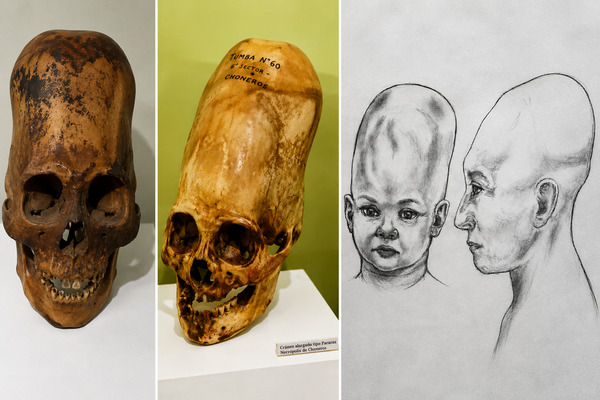
Known as the Paracas Skulls, or simply the Elongated Skulls, these unusual human remains were unearthed in Peru around 100 years ago. They exhibit a striking characteristic: extraordinarily elongated craniums, which many archaeologists attribute to the practice of intentional cranial deformation, likely achieved through the compression of the skull during infancy.
Not everyone, however, is convinced by this explanation. Some independent researchers and enthusiasts have argued that these mysterious skulls could represent evidence of extraterrestrial visitation in the distant past, or at least an attempt by ancient peoples to imitate supposed “gods” who descended from the heavens.
The fact that numerous previous studies have failed to reach a definitive conclusion has only fueled the debate.

Now, researchers from Liberty University in Virginia have examined teeth taken from the Paracas skulls, a collection of more than 300 ancient human remains discovered by archaeologists in Peru during the 1920s. Previous studies concluded that the cone-shaped skulls were most likely the result of intentional cranial modification practiced by a civilization that lived in the region between 800 BC and 100 BC. However, those conclusions were based primarily on morphological examinations and visual observations.
Several genetic analyses conducted over the years in an effort to determine the origins of the individuals produced inconclusive results. This prompted researchers to launch a new study using powdered material extracted from the teeth in an attempt to reconstruct more complete genetic profiles.
Controversial theories have persisted for decades, claiming that the mummies are the remains of non-human beings or even extraterrestrials. However, such claims have never been supported by conclusive scientific evidence.

Researcher Abigail McDowell explained: “Some archaeologists and geneticists attributed the deformation to the cultural practice of cranial compression, which uses pressure to shape the skull and often served as a symbol of social status, wealth, or importance.”
“Others believed that the Conehead mummies were evidence of extraterrestrial visitors, claiming that the mummies were descendants of non-human species or even aliens,” she added.
Even after analyzing several teeth from the Paracas individuals, the scientists reported that they were unable to obtain enough genetic material to definitively determine their biological origins. According to the researchers, the results remain inconclusive due to the condition of the samples and the limited amount of recoverable DNA.
In an effort to clarify the origins of the famous elongated Paracas skulls, researchers turned to one of the most durable structures in the human body: teeth. Because they can preserve biological material for thousands of years, teeth are considered one of the best sources for recovering DNA from ancient human remains.
Scientists at Liberty University focused their efforts on extracting genetic material from teeth belonging to individuals found in the Paracas necropolis in Peru. To increase their chances of success, they employed two different procedures.

The first method sought to preserve the samples as much as possible by removing only small amounts of material from inside the tooth root. The second technique was more aggressive, involving the complete pulverization of the teeth to release any DNA still preserved within them.
After collecting the samples, the researchers analyzed the amount of genetic material recovered. The results showed that the full-grinding technique was significantly more effective, producing more than five times the amount of DNA obtained through the conservative method.
Despite this, the numbers fell below expectations. The less invasive procedure yielded only 2.3 nanograms of DNA per microliter, while the complete grinding method reached 14.1 nanograms per microliter. Although the difference was considerable, both samples remained below the level normally required for detailed genetic analyses.
According to the researchers, specialized laboratories typically require at least 20 nanograms per microliter for sequencing equipment to generate reliable and complete results. As a result, the amount recovered was insufficient to reconstruct a genetic profile capable of answering questions about the ancestry of the individuals studied.

Even so, the findings were considered encouraging. Since all of the samples analyzed contained detectable traces of DNA, the team concluded that the issue was not a complete absence of genetic material, but rather a high degree of degradation caused by the passage of time.
The researchers intend to continue their investigations using more advanced techniques. Among them is a process known as demineralization, which may help release greater quantities of DNA preserved inside the teeth.
If higher-quality samples can be obtained, the scientists plan to compare them with genetic material already recovered from hair attributed to the same individuals. The hope is that combining these analyses will ultimately provide stronger clues about the biological origins and population history of the elongated-headed people.