


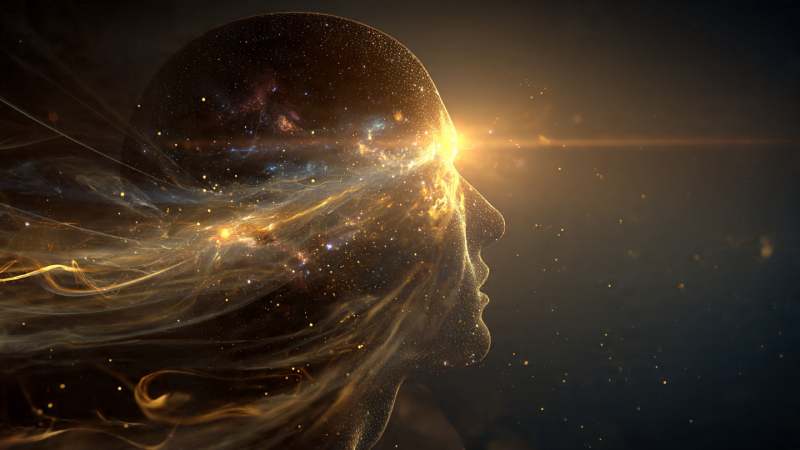
Is consciousness the result of brain activity, or is it actually the very foundation of the universe? This is the central premise of a new theoretical model presented by Professor Maria Strømme, recently published in the prestigious scientific journal AIP Advances.
The article, which was selected as the best of the issue and featured on the cover, represents a bold leap from materials science into cosmology and theoretical physics. Strømme argues that consciousness is fundamental; only after it do time, space, and matter emerge.
The professor of Materials Science, best known for her research in nanotechnology, proposes a framework in which consciousness is no longer viewed as a mere biological byproduct. Instead, she describes it as a fundamental field underlying everything we experience, including life itself.
“It’s a theory in which consciousness comes first, and structures like time, space, and matter arise afterward. It is a very ambitious attempt to describe how our experienced reality works,” the researcher explains.

Despite the boldness of her proposal, Strømme notes that she is not alone in this pursuit. Historical physicists of the stature of Einstein, Schrödinger, Heisenberg, and Planck explored similar ideas, and her work seeks to build upon the paths they opened, using the language of physics and modern mathematical tools.
The Swedish expert’s model seeks to reconcile quantum physics with non-dual philosophy. The theory suggests that individual consciousnesses are parts of a larger, interconnected field. From this perspective, phenomena often dismissed by traditional science as “mysterious” —such as telepathy or near-death experiences— could be explained as natural consequences of this shared field.
Faced with this ambitious reformulation of reality, the study’s author poses a key question that challenges their traditional classification: “Are these phenomena truly mystical? Or is it simply that there is a discovery we haven’t made yet?” She compares this potential shift in mindset to the historical moment when humanity understood that the Earth was round.

Credit: M. Strømme.
However, this is not a theory confined to philosophical speculation; the article offers testable predictions in fields such as physics, neuroscience, and cosmology. In fact, one of the most fascinating aspects of her theory is the suggestion that individual consciousness does not cease with biological death, but instead returns to the universal field from which it emerged.
This claim stems from her groundbreaking view of matter: “I am a materials scientist and an engineer, so I’m used to seeing matter as something fundamental. But according to this model, matter is secondary; much of what we experience is representation or illusion,” she states.
Although the work is written strictly in the mathematical language of physics, its reasoning resonates with ancient religious and philosophical traditions. The researcher points out that texts such as the Bible, the Qur’an, and the Vedas often describe an interconnected consciousness using metaphors.
“The early quantum physicists arrived at similar ideas using scientific methods. Now, it is time for hard science —that is, modern natural sciences— to begin exploring this seriously,” Strømme concludes.