


In March, a team of Italian researchers drew global attention after claiming to have identified a massive underground structure beneath the Giza Plateau in Egypt — a complex that extends nearly 1,067 meters (3,500 feet) below the surface and links together enormous chambers comparable in size to entire city blocks.
Now, new information further strengthens that claim. Filippo Biondi, the radar engineer behind the innovative imaging technique used in the survey, has decided to make public the body of evidence that he says leaves virtually no room for doubt.
In a recent interview on Jesse Michels’ podcast American Alchemy, Biondi revealed that four independent satellite operators — Umbra, Capella Space, ICEYE, and Italy’s Cosmo-SkyMed — returned raw tomographic data that perfectly matched one another, all displaying the same subterranean structures.
“All four satellites produced exactly the same results,” Biondi said. “It’s extraordinary. We could never make any announcement without these fundamental scientific validations.”
The team employed a pioneering method known as Doppler tomography using synthetic aperture radar. The technique analyzes microscopic vibrations on the Earth’s surface that carry acoustic signatures of objects located thousands of meters below ground. With these “fingerprints,” the software reconstructs three-dimensional models even though the radar waves themselves never need to penetrate the soil.
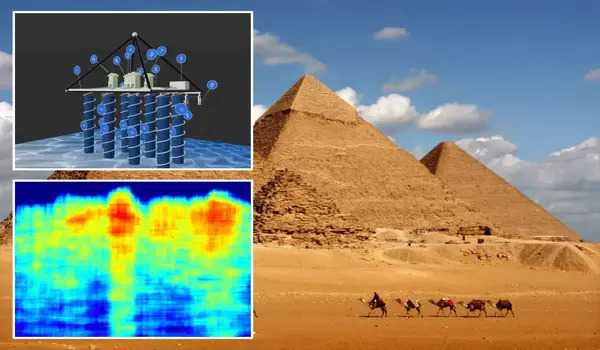
The reconstructed images reveal eight massive hollow cylinders descending vertically beneath the base of the Pyramid of Khafre, the middle pyramid of the three great monuments at Giza.
Each shaft contains a central column wrapped in perfectly symmetrical helical spirals and terminates in vast cubic chambers measuring roughly 260 × 260 × 260 feet — larger than many modern sports arenas.

“The pyramids are only the tip of the iceberg,” Biondi said. “They act as a capstone for something much larger that lies beneath. The real core is down below.”
When asked whether the helical structures could be natural formations, he responded without hesitation: “Absolutely not. They are man-made. You simply don’t find perfect spirals like these in geology.”
Even so, several prominent experts — including renowned Egyptologist Dr. Zahi Hawass, who even addressed the topic during a heated debate on the Joe Rogan podcast — dismissed the claims as soon as they surfaced, labeling them as “fake news.”
Hawass challenged the findings, arguing that the radar technology used by the Italian team cannot penetrate anywhere near the depth they are suggesting beneath the pyramids.

However, the criticism did not slow the researchers down. They reported detecting a smaller version of the same helical signature beneath the third pyramid, that of Menkaure, as well as a single massive shaft beneath the Sphinx.
An identical spiral-axis geometry was also detected 48 kilometers away in Hawara — the site ancient writers described as the legendary Labyrinth.
The Giza complex consists of the pyramids of Khufu, Khafre, and Menkaure, built around 4,500 years ago on a rocky plateau on the west bank of the Nile.
So far, the team claims to have measured depths exceeding 3,280 feet — more than half a kilometer beneath the surface.
The detected structures appear as tube-like formations — eight in total — descending from the base of the pyramid into enormous chambers roughly 260 feet wide and 260 feet tall.
The scans also detected a spiral-shaped structure wrapped around each of the eight shafts.

Biondi acknowledged that he and his team still don’t know the purpose of these formations, but suggested they might represent ancient staircases or some type of coiled cabling surrounding the shafts.
“I can say that this structure — these tubes extending beneath the pyramid — appears to be related to information,” he said. “Generating energy is a form of information. Information is everything.”
To counter skeptics who claimed the images were nothing more than AI hallucinations, Biondi pointed to a series of blind tests — including one in which his method produced a flawless reconstruction of Italy’s Gran Sasso underground physics laboratory, buried inside a mountain 200 kilometers away, with 100% accuracy.
The team has already submitted a formal proposal to Egyptian authorities under the Khafre Research Project.
According to the plan, no drilling would be required. The existing shafts between the Sphinx and the Pyramid of Khafre — currently clogged with centuries of debris — appear, based on the scans, to be service entrances leading directly into the one-kilometer-deep complex.
🚨BREAKING: New Radar Scan Reveals a Massive Engineered Substructure That Looks Like An Energy Grid Beneath the Giza Plateau🚨
Radar engineer Filippo Biondi just dropped the most explosive finding ever reported at Giza: eight clearly man-made, tube-like structures plunging more… pic.twitter.com/ZFctuLJPYZ
— Jesse Michels (@AlchemyAmerican) December 7, 2025“We just need permission to clear the shafts and go down,” Biondi said. “If approval comes before the end of the year, physical exploration could begin as early as 2026.”
Podcast host Jesse Michels, visibly astonished, wrapped up the interview by saying, “After this conversation, I’m convinced of a lot. This kind of discovery is accelerating. Humanity feels like it’s ready.”
Below, you can watch the full episode on Jesse Michels’ channel.